
Hey there, friends! Ready to learn Portuguese? In this Dica do Dia we’ll talk about the very first football team founded in Rio de Janeiro. While the other big teams like Flamengo, Botafogo, and Vasco started as rowing clubs and later created football departments, Fluminense was established as a football club from the very beginning. They are affectionately known as the Tricolor, a nickname that refers to the club’s iconic three colors: maroon, green, and white! Have you ever heard of this team?
In this Dica, you’ll explore the rich history of Fluminense Soccer Club, from its founding in 1902 to its iconic pó de arroz tradition. Learn about its biggest titles, the meaning behind its legendary jersey, and the players who became club legends. We’ll visit its historic stadiums, dive into curious facts, and even offer a vocabulary list at the end to help you learn Portuguese while getting to know this legendary team!
Let’s travel back in time to the golden days of Rio, when trams rattled down the streets and football was just beginning to capture the city’s imagination. It was July 21st, 1902, when a young man named Oscar Cox, a Brazilian of English descent and a passionate football lover, gathered a group of friends in the neighborhood of Laranjeiras. His goal? To found a club entirely dedicated to the sport he had fallen in love with while studying in Switzerland. That’s how Fluminense Football Club was born, the first of Rio’s big teams to be founded specifically as a football club, not a rowing club.
Fluminense’s first home was none other than its very own Laranjeiras Stadium, which later became a symbol of Brazilian football history. From the beginning, the club stood out not only for its pioneering spirit but also for its elegant style and strong performances on the field. It quickly earned a loyal fanbase and dominated local championships in the early 20th century.
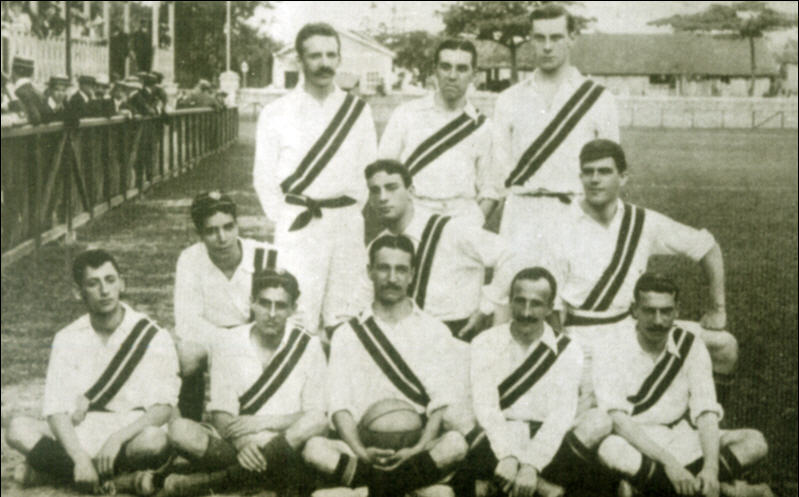
Now, let’s talk about one of the most curious traditions in football: the “pó de Arroz” (Rice Powder) story. Around 1914, a Fluminense player named Carlos Alberto applied rice powder to his face before matches. Some say it was to help with shaving; others claim it was due to racial pressure at the time. Rival fans started mocking him, shouting “pó de Arroz!”, but Fluminense fans turned the taunt into a celebration. To this day, Tricolor supporters throw rice powder in the air when the team enters the pitch, embracing the nickname with pride and turning it into a powerful symbol of identity and resilience. The tradition lives on, to this day, the Fluminense torcida throws rice powder into the air during game days, creating a beautiful visual effect in the stadium that fills the air with history, pride, and a touch of Tricolor magic.
One of the most iconic things about Fluminense, besides its loyal fans and dramatic victories, is its classic logo. Since the club’s founding in 1902, the Fluminense emblem has remained remarkably consistent.
The shield-shaped logo features the club’s traditional green, maroon, and white colors and the elegant intertwined initials FFC, standing for Fluminense Football Club. There have been small modern tweaks here and there, like sharper lines or updated fonts, but the overall design has proudly stood the test of time. Just like its fans, it’s bold, traditional, and unmistakably Tricolor.

In the team’s very first game, Fluminense Football Club overcame its opponent (at the time was Rio Football Club) 8 x 0. In addition, it also became the champion of the first edition of the Carioca Championship beating all its opponents. After that title, it continued on to win the championship for four more consecutive years.
In addition to winning regional titles, Fluminense also sought their place in the national football scene achieving some important titles for its history. Let’s see some of these important titles, check it out:
This is what makes Brazilian Football Club Fluminense one of the most popular teams in Rio de Janeiro, amassing fans all over the city and of course all over Brazil.

🔴 Fluminense soccer team has 5 million fans worldwide and 34,000 official members
⚪ It has one of the highest fan engagement rates in Brazil
🟢 Laranjeiras Stadium and Club are considered part of the Brazilian Cultural Heritage
🔴 The First Brazilian World Cup goal was scored by a Fluminense player (Uruguay, 1930)
Fluminense is a stage for football legends. Over the decades, the Tricolor jersey has been worn by some of the most iconic names in Brazilian football, players who made history, won titles, and left their mark on the hearts of fans. Meet the heroes who turned passion into history:
The legendary goalkeeper made over 700 appearances for Fluminense between 1947 and 1964. Fans admired Castilho for his lightning-fast reflexes, unmatched consistency, and unwavering loyalty to the Tricolor. He helped Fluminense win multiple Campeonato Carioca titles and led the team during its golden era. Fans nicknamed him “Saint Castilho” for his talent and sportsmanship. To this day, the torcida in Laranjeiras fondly remembers many of his heroic saves.

Bust of Castilho at Fluminense HQs. Source: Wikimedia Commons

A brilliant defender and natural leader, Carlos Alberto Torres played a pivotal role in Fluminense’s defense during his time at the club, especially during his first spell from 1963 to 1966 and a brief return in 1976. While he is widely celebrated for captaining Brazil to World Cup glory in 1970, his impact at Fluminense was equally significant. He brought composure, tactical intelligence, and leadership to the team, helping to shape a strong era for the Tricolor.
Carlos Alberto Torres in Paris, 1976. Source: Wikimedia Commons
One of the greatest midfielders in football history, Roberto Rivelino played for Fluminense from 1975 to 1978. Known for his powerful left foot, precise dribbling, and free-kick magic, Rivelino brought flair and prestige to the team during the memorable period known as the Máquina Tricolor. His presence elevated the club’s profile and delighted fans, leaving a lasting legacy that’s still celebrated today.

Rivelino, 1970 World Cup. Source: Wikimedia Commons – Public Domain (via Agência Nacional)

Charismatic, cheeky, and skillful, Renato Gaúcho brought flair and unforgettable goals to Fluminense. He had several spells with the club as a player, notably in the 1980s and 1990s, and also coached the team in the early 2000s and again in 2009. He played with style and personality that matched the spirit of the club. Later, he also took on the role of head coach, continuing his story with the team from the sidelines. Whether on the field or on the bench, Renato remains a beloved figure among Tricolor fans.
Renato Gaúcho. Source: Wikimedia Commons
Before becoming one of the world’s most respected defenders and shining in European clubs and the Brazilian national team, Thiago Silva began his professional career at Fluminense. He played for the club from 2006 to 2008 and returned in 2024, making an emotional comeback to his roots. During his early years with Flu, he quickly became a fan favorite for his composure, tactical intelligence, and leadership on the field. His performances were key in helping the club reach the final of the Copa Libertadores in 2008. Even after conquering the world abroad, Thiago Silva never hid his affection for Fluminense, and his return is seen as a homecoming for a true Tricolor idol.

Thiago Silva in 2007. Source: Agência Brasil – Licensed under Creative Commons Attribution 2.5 Brazil

A true modern-day idol. Fred became one of the most iconic strikers of his era, especially during his two long stints with Fluminense: from 2009 to 2016, and then again from 2020 to his retirement in 2022. Fans admired him for his goals, leadership, and deep connection with the Fluminense fanbase. He proudly wore the Brazil national team jersey, representing his country in multiple tournaments, including the 2014 World Cup. At Fluminense, he claimed national titles, ranked among the top scorers in club history, and inspired teammates with his presence on and off the pitch. Fans and teammates honored him with an emotional farewell at Maracanã, closing an unforgettable chapter in Tricolor history.
Fred during Confederations Cup 2013. Source: Wikimedia Commons
These stars are just a few of the many greats who’ve passed through Laranjeiras and helped shape the proud legacy of the Fluminense Soccer Club.
Fluminense plays its home matches primarily at the iconic Maracanã Stadium, the most famous football stadium in the world. Shared with other Rio teams, Maracanã hosts the biggest matches and derbies, offering a stage worthy of the club’s grandeur and its passionate torcida.
But the heart and soul of Fluminense is its historic Estádio das Laranjeiras, located in the Laranjeiras neighborhood where the club was founded. Although it’s no longer used for major matches, this stadium holds a special place in Brazilian football history. Opened in 1919, it was the first football stadium in South America and even hosted matches for Brazil’s national team in the early days. Today, it serves as a training ground and the spiritual home of the club, preserving the roots and traditions of the Tricolor.
Want to experience the passion up close without having to fight for Fluminense tickets? Join us for our unforgettable RioLIVE! Maracanã! You’ll get to feel the roar of the crowd, wave your own pó de arroz, and watch the Tricolor in action at one of the most iconic stadiums in the world. It’s not just a game, it’s a full-on cultural immersion, football, Portuguese, and carioca spirit all in one day!

Fluminense’s uniform is more than just a kit, it’s a statement of tradition and identity. Fans even refer to the jerseys as true “armaduras” (armors) because when the players wear them, they carry the weight of history, pride, and passion on their backs. The club’s iconic tricolor stripes — maroon, green, and white — make it one of the most recognizable and stylish jerseys in Brazilian football.
Throughout the years, the club has also released special edition shirts that pay homage to historical moments, legendary players, or milestones. You can find many options in the Official store, but here are the main ones:

The Home Kit: typically features vertical stripes in the traditional colors.
The Away Kit: usually brings a clean white base with elegant accents in maroon and green.

From the earliest photos of the 1900s to modern matchdays at Maracanã, the Fluminense jersey has evolved in design but never strayed from its roots. It symbolizes pride, elegance, and a passion that stretches over a century.
Whether worn by legends like Castilho and Fred or waved in the stands by devoted fans, the Tricolor uniform represents the soul of Fluminense Football Club.
Finally, to make sure you got it, we made a Vocabulary list to get you sharp before getting to a Fluminense match:
| Fluminense Football Club | Clube de futebol Fluminense |
| Carioca clubs | Clubes de futebol cariocas |
| White powder | Pó de arroz |
| Fans / supporters | Fãs / torcedores |
| Championship | Campeonato |
| Regional titles | Títulos regionais |
| National football | Futebol nacional |
| Laranjeiras Stadium | Estádio das Laranjeiras |
| Founded | Fundação |
| Rowing clubs | Clubes de remo |
| Titles | Títulos |
| Players | Jogadores |
| Nickname | Apelido |
| Game | Jogo |
| Opponent | Adversário |
| Champion | Campeão |
| Stadium | Estádio |
| Goal | Gol |
Now, tell us! Had you heard of Fluminense Fluminense Football Club before? Do you know any other team in Rio de Janeiro?
See you for our next Dica!
Big hug from Rio de Janeiro!
Click on the links below to see more related Dicas
Origin of Brazilian football
Flamengo Football Club
Botafogo Soccer Club

A native Brazilian Portuguese speaker with a degree in Languages (Portuguese and English) from UFRJ, she has over eight years of experience teaching languages, specializing in Portuguese for international students. Passionate about communication, she combines creativity and precision to make learning Portuguese engaging, enjoyable, and culturally immersive. Her global experience and strong connection with diverse cultures enable her to create dynamic, tailored lessons for learners worldwide.
Search for Portuguese Dicas
Tell us which Portuguese lesson you would like to learn
This post is also available in:
 English
  Português (Portuguese)
  Español (Spanish)
  Français (French)
Search for Portuguese Dicas
Tell us which Portuguese lesson you would like to learn
Suscribe to A Dica do Dia.
Get free Portuguese lessons. Subscribe to A Dica do Dia and get short, daily lessons in Portuguese completely free.


Excellent rating
Based on 480 reviews
 I've been a student at the school for 6 months in the part-time online group program. I find the experience of studying Portuguese at Rio & Learn very interesting; the classes are lively and fun, and the teachers are great, especially Igor, Sabrina, Leo, and Rafael. I hope to one day be able to participate in the live activities in Rio.
(Translated by Google, see original) Gustavo Olstein14 August 2026I continue to have such a positive experience working with the team! They are kind, responsive, professional, and very good about tailoring the private courses to your exact level and goals. If I could give them 10 stars I would! I continue to work with them because of how great they are. Can’t recommend this group enough!
 Brady Marchewka13 August 2026An excellent school, in addition to offering many great field trips. Teachers are top-notch!
(Translated by Google, see original) Juliana Teixeira12 August 2026Very good, I recommend it!!! It also has the best teacher and supervisor (Yasmin) 😁
(Translated by Google, see original) Igor12 August 2026
 Elís Vitória11 August 2026I follow Rio & Learn on Instagram and I love their content! The videos are always fun, creative, and show a very different way to learn Portuguese, mixing the language with the culture and daily life of Rio de Janeiro. You can see the care and dedication of the team in each piece of content. Even though I'm not a student, I always end up learning something new.
(Translated by Google, see original) Edilamar Teixeira11 August 2026Professor Yasmin was wonderful! She helped me a lot and I am very grateful to her; she made everything seem easier, lighter, and more fun.
(Translated by Google, see original) Belize Fausto11 August 2026Rio & Learn has a very different approach from a traditional school. What I like most is that Portuguese isn't just taught in the classroom; students have many opportunities to truly practice while exploring Rio, Brazilian culture, and meeting people from all over the world. The atmosphere is super relaxed and fun, and the staff makes everyone feel welcome from the start. The RioLIVE! events are definitely one of the best parts, because you learn Portuguese while discovering incredible places and having experiences you probably wouldn't have as a typical tourist. I highly recommend it!! 🫶
(Translated by Google, see original) Yasmin Spinelli11 August 2026Excellent school! It transforms education into fun, making learning lighthearted. Competent teachers, interesting activities, extracurricular Brazilian dance classes, and much more!
(Translated by Google, see original) Alanis Gonçalves11 August 2026Fantastic methodology, personalized service, and endless discussion! Excellent teachers with engaging and creative classes.
(Translated by Google, see original) Augusto Kath10 August 2026The dedication of the teachers and the differentiated teaching model make this school one of the most original in Rio de Janeiro. The students truly integrate into the city's routine and experience Rio in an authentic way.
(Translated by Google, see original) Alex Cabral Silva9 August 2026Hey everyone! Studying Portuguese is one thing; getting to know, share, and live the language is quite another. The teachers, activities, and staff are really great. The extracurricular activities are very useful for getting to know the city and improving vocabulary. Also, I'd like to talk about the dance classes I took; the teacher was really cool, I learned rhythm and dance very well, and I'd love to go back and dance more.
(Translated by Google, see original) Néstor Piñas7 August 2026I stayed at this school for three weeks. It would be simplistic to say I only learned Portuguese; this school offers much more than that. An immersive experience in the city of Rio and its surroundings. The teachers are fantastic and will guide you in learning the language and discovering all that Rio de Janeiro has to offer. The entire team is wonderful, extremely helpful and professional, and the courses are very well structured. I recommend this school to anyone who wants to learn Portuguese and discover what it means to live in Rio. I'm sure that, like me, you'll love it. 😉👍🏾❤️
(Translated by Google, see original) Fabio Capriotti7 August 2026The best Portuguese school: thanks to its innovative method, students are able to communicate in a very short time; the activities and teachers are incredible. If you want to live an experience that will change your life and open your mind, this is the right choice.
(Translated by Google, see original) Juan X5 August 2026I’ve just finished my three-week solo trip to Brazil, and I can honestly say that choosing Rio & Learn was one of the best decisions I made. When I arrived in Brazil, I was very nervous about speaking Portuguese. I understood more than I could speak, and I was afraid of making mistakes. From the very first day, the teachers and everyone at the school created such a welcoming and supportive environment that I quickly gained the confidence to push myself and speak more every day. They made learning fun and encouraged me to step outside my comfort zone. I would recommend Rio & Learn to anyone coming to Rio, no matter your level of Portuguese. The school offers the perfect balance between learning the language and experiencing Brazilian culture. The classes are engaging, and the daily activities allow you to explore the city, meet incredible people from all over the world, and make memories that will last a lifetime. More than just a language school, Rio & Learn feels like a community. I arrived alone, but I'm leaving with new friends, unforgettable experiences, and much more confidence in my Portuguese. A huge thank you to all the teachers, staff, and students for making these three weeks so special. I hope to see you all again one day!
 Daniel Sundqvist26 July 2026It is a school where you feel very comfortable and all the staff are very nice and attentive to your needs, they are fantastic. I really appreciate the treatment received by all the staff.
(Translated by Google, see original) Edita Pueyo Aragon24 July 2026Top-notch Portuguese lessons that have enabled me to speak Portuguese fluently. The teachers are very encouraging, motivating, and always attentive to adapting the lessons and activities. I highly recommend them to anyone who wants to learn Portuguese.
(Translated by Google, see original) ELYSE VERNEZ23 July 2026Excellent school, both online and in person, with attentive teachers; highly recommended.
(Translated by Google, see original) Anne catherine Marcant23 July 2026Excellent communication, easy interaction with the instructors and highly competent teachers, and a top-quality online service. I highly recommend it for making rapid progress in Portuguese.
(Translated by Google, see original) Théo Marcant23 July 2026
 Total disappointment, I left a good review and I have to change it, I'll share my complete experience: I need to completely change my previous review. Unfortunately, after leaving the immersion program, my experience with the Institute was very different and I was deeply disappointed. What bothered me most was noticing a lack of cultural respect in some situations, especially towards Argentinians. We are proudly Latin American, and I didn't expect this kind of attitude from a Brazilian institution that works precisely with language, culture, and exchange. I also find the way some discussions are conducted in the WhatsApp group contradictory: some people can express strong opinions, but when someone responds or presents a different viewpoint, that same freedom doesn't seem to be accepted. I am very proud to be Argentinian and of my Latin American identity. I believe in cultural exchange, but it needs to happen with respect, listening, and appreciation of different cultures, without a sense of superiority or idealization of others. My first experience during the immersion program was positive, which is why I wrote a favorable review at that time, even after a request from the Institute itself. However, after subsequent events, my perception changed completely. For these reasons, I can no longer recommend the Institute. After this experience, I believe that the institution does not represent the cultural respect and exchange that should exist in a space dedicated to the Portuguese language. Furthermore, I noticed a strong focus on English and little on Spanish, which I consider a major limitation for Latin American students seeking to learn Portuguese. My recommendation is to exercise caution before choosing this institution.
(Translated by Google, see original) Camila Valeria20 July 2026I've been studying online with Rio&Learn for a few months. I'm in Chicago. My teacher, Rafael Silva de Souza (in Recife), is excellent: patient, clear, and very friendly. The classes have a perfect mix of conversation and formal structure.
(Translated by Google, see original) Peter Thompson10 July 2026I spent five weeks at Rio&Learn. I quickly learned the basics of Portuguese, which helped me get by in everyday life here in Rio and to meet and chat with new people during my trip around Brazil. The group classes are small, with a maximum of six students. This is perfect for everyone to participate and practice speaking. Sometimes we go on an immersive outing during class to practice speaking in a shop, a café, or on Copacabana beach. In the afternoons, there are organized activities that allow us to continue practicing the language, but also to make friends with other students, while visiting Rio or taking a dance class or playing footvolley on the beach. Thanks to the amazing teachers Amyna, Alanis, Rapha, Yasmin, Antônio, and Thalles! The teachers are fantastic, friendly, and always motivated, even when we're struggling and tired! And let's not forget Thomas, who greets us every morning with a smile, always attentive to the students, and ready to offer advice on life in Brazil (visas, travel, daily life, etc.). I felt right at home here. It was a pleasure to come to school every day. I met amazing people from all over the world, with whom I went out, spent weekends, and continued exploring Rio outside of class. For me, it was a fantastic experience, so I highly recommend Rio&Learn to start learning Portuguese, meet new people, and discover Rio, "a cidade maravilhosa"!
(Translated by Google, see original) Claire Moissard10 July 2026We had an amazing experience here, sadly just for one week. Great teachers and an amazing personal approach to learn Portuguese as well as Brasilian culture. Perfect place to learn Portuguese for whatever period suits in your travels!
 Robert Poleé26 June 2026My experience at Rio&learn was perfect. I studied online courses and learned a lot. The teachers are super nice, they help with difficulties, check if we have understood correctly, and even provide follow-up for those who want to go to Copacabana in Brazil. For my part, I am very happy with what they taught me. The atmosphere is very friendly and welcoming. I really recommend it 👍👍.
(Translated by Google, see original) Brisa Sa10 June 2026Can’t recommend Rio & Learn enough. I started with zero confidence, but their online lessons focus entirely on conversation, starting with small, manageable chats and building up from there. The teachers are fantastic—patient, encouraging, and great craic. It never feels like a rigid grammar lecture; it just feels like a natural conversation that gets a bit more advanced as you improve. If you want to actually start speaking the language without feeling overwhelmed, this is the way to do it.
 Adam M2 June 2026I will return to this school without hesitation every time I come back to Rio! I spent several weeks at this Portuguese school and I can only recommend it. The teaching method is truly incredible: we learn without even feeling like we're in a school; everything happens naturally, dynamically, and interactively. Progress is real and fast, even after just a few weeks. The teachers are excellent, very didactic, patient, and always motivating. The environment is also a great differentiator: welcoming, friendly, and international, making you feel comfortable from day one. In addition to classes, the proposed activities allow you to practice the language in real-life situations while discovering the local culture. It's a truly enriching human and linguistic experience 🥰 A perfect school to learn Portuguese while living an unforgettable experience!
(Translated by Google, see original) Eva D2 June 2026I loved my two weeks in the advanced course at Rio&Learn. The school allows for total immersion in the language, with interactive classes in the morning and activities in the afternoon. I had the opportunity to take classes with almost all the teachers, because they change frequently. This greatly helps to hear different accents and to study with various teaching styles. I particularly enjoyed Yasmine's group classes, as they allowed us to debate social issues and taught me how to defend my point of view in Portuguese. I want to highlight and thank Antônio immensely for his dedication, giving me 10 hours of classes in just two days. His academic background and teaching qualifications were evident to me: the structure of the classes and his teaching methods were impeccable. He managed to deliver 5 consecutive hours of classes in an extremely fluid way, offering very interesting, in-depth content perfectly adapted to my level. It was a privilege to exchange ideas with such a qualified professional on social issues. I also want to express my immense gratitude to Alanis for the forró dance classes. She has incredible energy, impeccable professionalism, and enormous patience for teaching. It was a great pleasure learning from her; her dedication to her students is beautiful to see.
(Translated by Google, see original) Valentin Hytte26 May 2026Great teachers and atmosphere!
 Edo Luff26 May 2026I spent four weeks at Rio&Learn and want to be honest about both what worked and what didn't, because the second part matters more than a star rating captures. On the language side: the in-person group format helped me build a social circle in Rio quickly, which I valued. We laughed every single day in class. But for $800–900, my grammar and speaking didn't progress meaningfully more than they would have with cheap online private lessons. The "live learnings" outside the classroom were underplanned — one ended in a dead-end alleyway, another just involved baking in the Rio mid-day heat on the beach. In frequent debates that were intended to get students to talk about complex topics, our teacher talked over students rather than facilitating and frequently these conversations turned into her diatribes about what she was most passionate about. In private lessons, I asked a teacher named Rafaela to correct my written journal in Portuguese, an approach a previous teacher had agreed to, and she seriously resisted. These are service-quality issues a prospective student should weigh against the price. The harder part: the classroom environment had constant sexual undertones. In one class we were asked to rate the attractiveness of teachers, which all my classmates and I refused to accept this assignment. One teacher showed an image of a strap-on when the class had explicitly asked her not to bring that kind of content in. She started to show us on the computer, but when students got up and covered the screen, she decided against that, and instead showed us a pink strap-on from her phone. Hmmm how do I make this next comment without my review being banned? This same teacher also made a comment that straight men wanting to be a receptive partner is inappropriate — language that read as homophobic to me and to others in the room. The incident I also want future students to know about involved Albert, who manages the school. He approached me for using the private bathroom stall marked for females when the one marked for males was being used. As a queer person, I don't identify so strongly with these gender norms. He compared me to his own kid, suggesting that I wouldn't be able to use a female's bathroom cleanly. I pushed back in the moment, but the encounter stayed with me — every subsequent bathroom trip on the premises, I thought about him. I couldn't shake this deeply disturbing encounter. If you are queer and considering Rio&Learn, I'd want you to know this before you enroll. There are many ways to learn Portuguese in Rio. This one came with a cost beyond tuition.
 Charles Orgbon III26 May 2026Had an AMAZING experience with Rafael at the Rio & Learn Immersion Program in Recife. This program is perfect for those who want to get more comfortable speaking in Portuguese while also exploring the city of Recife, Olinda and other areas if you want! It’s for all levels and Professor Rafael meets you where you are at, language proficiency wise. I did two eight hour immersion courses and Rafael was awesome. He made 8 hours pass by in 5 minutes while helping me practice using more complicated verb tenses like “preterito mais-que-perfeito do subjuntivo” all while talking about the culture and history of Recife and Olinda. Excellent professor and excellent program highly recommend!
 Bella Socha19 May 2026I had the best time with my teachers there. I also made so many friends and became fluent in Portuguese in less than 4 weeks, because the teachers made it so fun! Dudu, Jasmin, Thalles, Jonathan, Antonio, all of them were so kind and generous. My time in Rio wouldn’t have been the same without this school. And the RioLIVE experiences after school were always so fun and made it super easy and exciting to discover the city while making friends and practicing Portuguese. Can’t recommend this enough!
 Luis Bracamontes10 May 2026Fantastic vibe! My friend is a student at the school so I was invited to go enjoy one of there weekend events, and it exceeded all of my expectations! Our guide Yasmin, who is a teacher at the school but also does the tours, was so amazing and knowledgeable! Everyone was having a blast and I feel lucky that I got to experience it:)
 Egemen Ustun7 May 2026Excellent school. A truly immersive experience. This school is perfect for practicing Portuguese and meeting people. The teachers are all friendly and very helpful. In the afternoons, they offer Rio Live, which are activities that allow you to explore the city and continue speaking Portuguese. I would recommend arriving with a basic knowledge of Portuguese (the school offers online classes) to get the most out of the school, but you can also learn on-site.
(Translated by Google, see original) Alejandro Javier Vegas Perkins21 April 2026A wonderful learning experience in every sense at Rio and Learn during this week. I learned much more than I expected!
(Translated by Google, see original) Andrea Levy11 April 2026I highly recommend Rio and Learn’s immersion course in Recife. I spent six hours a day for two and a half weeks with Rafael, an incredible teacher and warm and friendly person. The program was a perfect blend of conversation and structured lessons (which took place in cafes, park benches and beaches throughout the city) as well as a deep dive into the culture of Northeast Brazil. I came into the program at an intermediate level and am very happy with the progress I made in just a short time. There is so much to see, do and learn in Recife and Rafael is the perfect person to guide your language learning journey there.
 Jane D16 March 2026Awesome! Rio & Learn in Recife is fantastic. The teacher is damn good. I recommend it to everyone!
(Translated by Google, see original) Nylan Richard24 February 2026I purchased private online lessons from Rio&Learn at the beginning of the year, but the experience was very disappointing overall. There were repeated admin issues that seemed to interfere with almost single every class, including calendar invites being sent for the wrong day, being asked for my passport number (!) for no reason at all, and the team refusing to use the email address I said I preferred for communication. I also asked if the teachers could recap what we learned at the beginning of the next class, but didn't receive a reply back to that either... Which brings me on to my next point, the class content. The lessons were poor and fell short of what I was expecting. Each class is delivered through a cookie-cutter PowerPoint presentation, where I was mostly asked to repeat phrases and verb conjugation tables without being properly introduced to any vocabulary. I quickly realised this "method" of robotically repeating phrases would never work for me and cut my losses with the rest of the classes and moved onto something else. The teachers were very nice and I can't fault them, but I imagine they have very little control over what goes into the class planning, so I would avoid this company for the reasons mentioned above
 Lou16 February 2026I took part in an online group course for 5 weeks and it was a great experience. The school is very well organized, with flexible schedules, teachers are great and professional, the classes focus on conversation and grammar and most importantly I feel much more confident and skilled in speaking portuguese after this course. Also loved the fact that you have the opportunity to study with various teachers and that the school is focused on your individual progress and therefore may place you in different groups based on your performance. Super recommended!
 Luka Antonic13 February 2026Before the negatives, I wanted to say that I believe this school has good intentions and that it could work for some people. The neighborhood was very safe and conveniently located. That said, I strongly agree with some of the points made in other recent low ratings. Since I speak Spanish fluently and I studied Portuguese for a year in university 10 years ago, I thought private lessons would be most effective for me. My slightly unusual combination of strengths and weaknesses in the language made me concerned about fitting in well with one of the group classes - regardless of where they placed me. In the end, I chose Rio & Immersion and I was very excited for it. Going around the city with the teachers and visiting museums was really unique and special and I learned a lot about Brazilian history, culture and art. But the two teachers I had were unwilling (incapable?) to actually explain or teach more advanced grammar. It’s great to emphasize speaking but without some more proper/traditional instruction integrated into the program, I’m not sure how anyone could learn to speak proper Portuguese. Also, because Brazilians are the kindest people I’ve ever met traveling (seriously they are incredible), I have a feeling that they cut foreigners a lot of slack when it comes to making mistakes while speaking. This makes me wonder how well most students actually leave being able to speak despite their own glowing self-assessments and the “certificates” given out by the school. I understand that studying the more complicated grammar of a language isn’t the most fun thing to do, but learning a language properly is hard and that is a necessary part of it. My final straw was when I was told to “not worry about the subjunctive”… then after begging (forcing) them to put me back in a classroom, I was given an absolutely pathetic lesson on the subjunctive in Portuguese. The teacher was reading everything directly off the PowerPoint and wasn’t able to answer spontaneous questions I had about the topic. I booked a flight during my lunch break and flew home that same night. Both teachers I had were not professional educators but instead nice, educated young Brazilians that were working there while studying/looking for another job in another field as soon as possible. Maybe my initial instinct to do private lessons was misguided as it seemed like those students had a lot of fun with each other (but did they actually learn good Portuguese beyond an intermediate conversational level)? Just a guess, but I kind of doubt it. My final verdict is that this school could be a great match for total beginners and also perhaps some more advanced students who fit neatly in a “box”. But for someone looking for a customized plan like what I described earlier, I suggest that you to look elsewhere. (Additional info: I attended the school in March of 2025 just after carnival. I didn’t want my review to negatively affect my second teacher because she was very kind and tried her best with me. I worried that they could get in trouble with the intense manager but now enough time has passed and I imagine they have both moved on.)
 Jake Weiss7 January 2026I'm going to give my review in Spanish for the Latin American students who want to go to this school. What did I think? Well, from my experience, it was incredible! The people who work at the school were so kind to me and even helped me with a little problem I had before returning to Argentina. The teachers? They were amazing. I had two: Kesia and Eduardo (Dudu), and their classes were so dynamic and fun, and above all, they answered every question I had about the Portuguese language. Besides that, they were so friendly and kind to me. Although my stay was only two weeks, I felt the warmth of every member of the school, and that's something you don't find everywhere. The school is small, but there's an abundance of love for teaching and helping in any way they can. The support is constant. From my perspective: thank you all for everything. I hope to return soon because I really want to go back. I'm not giving it more stars because there aren't any, but for anyone who wants to have a really nice experience in Rio while sightseeing and learning Portuguese, Rio & Learn is the right place.
(Translated by Google, see original) Elena Valenci15 December 2025I had a wonderful experience improving my Portuguese with Rio&Learn. I have to give a big shoutout to Thomas. He was knowledgeable and communicated professionally to all the questions I tossed his way before I even signed up for any classes. That first impression was so positive that I decided to plan my two months trip in Brazil around Rio&Learn. I took two weeks of group classes and followed with daily private classes on the 3rd week. Their teaching method is unique and it really helped to build up my confidence. I enjoyed many of the very well organized RioLive activities. You also get to experience teaching style from different professors. I was very lucky to get my chosen professor for my private classes. Thank YOU, DuDu! I enjoyed my classes immensely and I highly recommend Rio&Learn.
 Mhari W8 December 2025Regarding the group classes: It's a fun environment and a good location but not good for actually learning Portuguese. The material moves far too slowly to actually become conversational. If you want to learn efficiently (both with your time and your money), then look elsewhere. If you already speak Spanish or Italian you will be put with beginners who only speak English/Dutch/German while most Portuguese schools offer separate classes. If you sign up for multiple weeks they will say you can not have any of your money refunded even though you are unsatisfied with the quality of the classes and want to leave after the first week.
 Sam Musler6 December 2025If you’re looking to take classes at Rio & Learn for just a week and explore Rio, then this school can be a fine option. However, if your goal is to seriously advance your Portuguese fluency, I’d recommend looking elsewhere. Make sure to read the reviews before making a decision—the older ones, unfortunately, still reflect what’s happening today. The curriculum doesn’t seem to have evolved, and classes often feel random and lacking in depth. If you stay for an extended period, be prepared to repeat the same material more than once. It’s clear that the teachers genuinely want to teach useful content, but they’re limited by a rigid structure they’re required to follow. Many of them end up leaving or being let go—I saw around six teachers leave or be fired within just three months. They do their best, but it’s tough to watch their motivation fade over time. Overall, the experience isn’t terrible for short stays, but for long-term learning or serious progress, I’d look for a more consistent and well-structured program.
 Trevor Tardanico2 December 2025If you wanna have a good time in Rio, learn about the city and have some basics in Portuguese, the school is fine. Now if your goal is to actually learn Portuguese, forget about it. The school has enough material for one month. After that, they repeat the subjects and you don't learn Portuguese anymore. They gonna take you out to museums or cafés and focus on their "fun learning" classes. Don't get me wrong, I don't blame the teachers. They are paid terribly and get in trouble if they teach too much grammar. It's the school system that I blame. They don't wanna teach Portuguese, it's just a service that they provide while constantly putting pressure on the teachers because of the fear of not being "fun enough". The owner is neither Brazilian nor a teacher. Think about it
 ouetca23 November 2025--> Check Glassdoor for another perspective on the rating <--- For having fun and getting started with Portuguese, it's not bad, even very good (2 weeks). However: - Almost all the teachers don't have qualifications to teach Portuguese as a foreign language (which doesn't diminish their merit, as most are competent at least up to the intermediate level) - The teaching content becomes repetitive quickly if you stay more than a month... - Ethically... the teachers are paid a pittance (below the already very low wages in Brazil). I don't recommend it for people who really want to learn Portuguese with the goal of living in Brazil. If I had been better informed beforehand about the possibilities of obtaining a student visa, I probably would have chosen another option, but hey, when you arrive in a new country, it's normal to make some mistakes. If you're thinking about a visa, try searching for yourself on forums and among expats before diving into this option ;)
(Translated by Google, see original) Nicolas U17 November 2025I had a fantastic experience at Rio & Learn during my six days on the immersion course. Sending a big hug to the whole team, especially my teachers Tayssa and Sarah! I highly recommend the course, as it allows you to start building vocabulary and becoming familiar with the language from day one, all while discovering Rio day by day. Thank you and hugs!
(Translated by Google, see original) Damià Matheu Haskell-Bell28 October 2025The best teachers and experience
 Adam Cook16 October 2025GREAT SCHOOL! The teachers are awesome!!! I did 2 weeks of Portuguese and I learned a lot. The teachers are great. They go out and do activities with us which is great for practicing the language. The school is super well located, the program is great. It was a GREAT experience. I highly recommend this school. Personally, I loved it so much that I will continue to learn remotely 😊
(Translated by Google, see original) Victoria Lavat3 October 2025I think the teaching materials need to be improved to improve my Portuguese conversation skills. The school and teachers helped me obtain a visa to stay in Brazil for more than three months. I was unable to participate in the teacher guidance activities in the afternoon due to my age and lack of energy, but I think the young people would be able to enjoy the tourist attractions of Rio de Janeiro.
(Translated by Google, see original) Toshiko Higashi6 August 2025I’ve been taking intensive Portuguese for the past 3 weeks at Rio&Learn and I love it! The instructors are dedicated and totally committed to helping students improve and move ahead. The administration is both responsive and helpful. Also, I’ve attended many good language schools in Europe, and the daily and weekend excursions offered at Rio&Learn are top notch and add so much value to the Brazilian cultural experience.
 r atkinson29 July 2025Huge thanks to the entire team at Rio & Learn, I spent a month studying here and I'd recommend it to anyone! You have a video call before you start at the school - to help determine which class you should be in, so that everything is ready to go for your first day. Naturally, the immersion technique is quite daunting on your first day or two, but in retrospect I couldn't recommend it enough to anyone that's eager to learn Portuguese and have the time of your life whilst you're doing it! The afternoon/evening activities are all fantastic, you'll get to meet people from all over the world, and get taught by some of the nicest teachers you can find! (e obviamente, um pouquinho em português): brigadão a toda a time da Rio & Learn, tive o melhor mês da minha vida aqui e nunca vou esquecer de todos vocês!!
 Nathan Story8 July 2025I can’t say enough good things about this school and its people. When I arrived in Brazil, I could only speak a few words of Portuguese. After just the first week, I found that I was able to start to communicate with people I met. After 6 weeks, I feel very comfortable having conversations with people. I watched them perform a miracle with another student who arrived with no Portuguese and whose native language was Asian. The staff is incredibly patient, friendly and helpful to the students. The activities offered for free in the afternoons and weekends also give you both an opportunity to practice your language skills and also explore Rio de Janeiro without paying for a guide. In addition, many activities take you to places not readily available to tourists so that you can see and experience the native life. If you are thinking about coming to Brazil, I would recommend you take at least a few classes online before arriving. I was very surprised that there is little to no English or Spanish speaking people even in the tourist areas. I wish I would have done this before I came. If I could, I would give this school much higher than 5 stars.
 Jeff4 July 2025The best portuguese school of Rio de Janeiro! The atmosphere is so friendly, all the staff is so welcoming and therefore they attract students with the same energy! The lessons are really interactive and the offer of the afternoon activities is always interesting and fun. And last but not least, the location is top, one block away from the seafront in Copacabana! What are you waiting for? Sign up!!
 Giulia Serena25 June 2025I have been taking classes at Rio & Learn for almost three months and I really recommend it. I have tried other schools as well and what I really like about R&L is that we don’t spend all the time doing grammar exercises. The teachers make the conversations engaging and you’re not only practicing conjugations but actually speaking and listening the way people talk in real life. Every class feels different and is based on custom material, not just repeating pages from a textbook. The classes are focused on helping you communicate, which is exactly what I was looking for.
 Åsmund Aamodt Resell14 June 2025Best language school I haver ever been! Very well prepared teacherswith fantástico knowledge. Durinho the classes we went out of school to speak to people on the Street in order to practice our Portuguese in real life. I loved this! But what I preferred the most was the afternoon out-of-school activities, 3xcursions completely free of charge. I admired the enthusiasmof our teachers who qccompani3d is ön these programs. Those wete that made a real differenc3e between Rio&Learn and other language school. The location of the school right next tó Copacabana and my home-stay were the top of everything. I highly recommend this school to everyone who needs tó study Portuguese in Brasil
 Rita Rétháti5 June 2025I enjoy the classes with Rio & Learn a lot. The structure and material they offer is of great quality. The professors make it fun to learn every day. Maybe that is actually the best part, the teachers. They are patient, they make you feel welcome and comfortable in the setting you are in. They try to get you to talk, engage in conversations, make jokes etc. Don't hesitate anymore, if you want to learn the language, contact Rio & Learn and they (together with you of course) will make that happen ;)
 Sacha van Giessen4 June 2025I've been learning Portuguese online with Rio & Learn since January as preparation for my Brazil trip in July/August and have had a great experience with them! The administrative team and my teacher Léo have been nothing but kind and accommodating. Léo incorporates a lot of historical and cultural parts in his classes, which I really enjoy. Looking forward to visiting the actual school in Rio soon😊 Muito obrigada!
 Laura Eggimann2 June 2025Whatever you think your experience here will be like, it‘s better than that. I took part in the group classes for 1 month and I don‘t even have the words to describe how much I enjoyed my time here. This is not the kind of school that puts a boring textbook in your face and calls it a day. You learn the language by being immersed in it 24/7, so from Day 1, you will be speaking portuguese. On my first day here, we went out into the city, talking about our surroundings, learned how to order in portuguese, etc. Every day here you will be talking about movies, music, what you‘re passionate about, learning about Brasilian culture, cuisine, anything you can think of. The classes all feel like you‘re learning with a good friend, for one because of how they‘re structured in such a fun way, but also because the teachers are some of the coolest people I‘ve met in Brasil. Your teachers will rotate, and all of them have their own unique way of teaching. But what they all have in common is that they are professional, funny and kind. They take their time with all the students and get everybody involved in conversations. I want to thank all of them for making my time here as incredible as it was. I want to thank Diogo in particular, who is one of the coolest people I‘ve ever met in my life. He has such a fun, vibrant personality and really engages with the students. My portuguese is not very good and I often struggle to understand what people are saying, but I understood every word he said, partially because he speaks loudly and clearly, but I think it‘s also because he’s just naturally funny and that everything he says is so interesting you can‘t help but pay attention. Every morning I‘d hear Diogo in the hallway, cracking jokes and telling stories. He‘s the kind of guy that just lights up the room. Thank you Diogo, and thank you to everybody else at Rio & Learn. I recommend this school to anybody looking to enhance their experience in Rio. This is possibly the best way to appreciate this beautiful city and country even more. The more I learn, the more I fall in love. Thank you for everything.
 Aris Hayes30 May 2025I’ve been studying at Rio & Learn for the past month. I started with in-person classes at the school, and now I’m continuing with online classes. I just want to say—I really love this academy! I chose Rio & Learn because they offer fun and engaging activities, but what I love the most are the teachers. Each teacher has a different style, and they rotate them, so you don’t always have classes with the same person. I love that! It gives you a mix of teaching methods, which really works for me. One of the best things about the school—both in-person and online—are the extra activities they offer. In Rio, the activities include visits to interesting places around the city. Online, there are daily conversation sessions, games, and topic-based discussions that make learning even more fun and dynamic. The in-person activities sometimes depend on having enough students join, due to logistics and transportation costs, so occasionally they get canceled—but that’s totally understandable and no one’s fault. They also have Dica do Dia, a free daily newsletter that’s excellent—not only for practicing Portuguese, but also for learning more about Brazilian culture. I’m still studying and planning to continue for the rest of the year! Special shoutouts: Tomás at the front desk—always super helpful on WhatsApp and responds with a great attitude. Dayane for her amazing customer service, flexibility, and quick response time. Alle, a great teacher and also a talented dancer! Dani, for her contagious energy. Marcelle, an excellent teacher—we had an epic class about the word fofocar that I’ll never forget. Sabrina, her online classes are incredible. I love how she makes me learn. When I say something in Spanish by accident, she’s like: “FORGET that word, say tchau—‘bye bye’ ” Sara, always super organized and creative—she brings activities that really help me use my imagination. Igor and Rafael, you two are awesome! Thanks for holding it down in the RioOnline space.
 Zuhe Gonzalez Romagosa4 April 2025I have been very pleased with Rio & Learn for my remote portuguese lessons. They are very helpful / responsive in scheduling lessons and the professors are very likeable, talented teachers. They offer lots of great little extras as well (like daily emails, informal (free) additional group sessions and whatsapp chats). Good people; better teachers!
 Peter Hyams1 April 2025I had a very good experience, the combination of classes in the morning and activities in the afternoon is very good both to learn and to have a better experience in Rio, a wonderful city.
(Translated by Google, see original) Yaneth Guerra31 March 2025I had the pleasure of attending Rio & Learn for 3 weeks of immersion and classroom work in February. I have to say that their interactive approach really got me speaking almost immediately. Despite a few days of "immersion headache," my brain suddenly flipped a switch and I could start speaking and understanding spontaneously without the need to organize my thoughts beforehand. Every teacher I had added their own personal touch and cultural nuance, which only served to enhance my cultural and linguistic awareness. I fully recommend Rio & Learn to anyone who wants to get out of their heads from theoretical language knowledge to actual application.
 Sergio Salazar26 March 2025I've studied here for a month and made amazing progress! I knew some basic Portuguese before coming here and I mainly needed practice in speaking - and it was exactly what I got! The classes are immersive - you only get to speak Portuguese, also during activities (they are pretty strict about that!). But because of that, I'm not sure if I recommend this school to someone who is just starting to learn from zero - some people I met at school were really struggling with that. Just learn some basics before! Every day you have a different teacher, which at first I thought was weird, but it actually works pretty well because they are all different - you also learn to understand different accents etc. But some teachers are better than others. Unfortunately, the difference can be huge. There were classes where teachers couldn’t properly explain grammar (being a native speaker doesn’t automatically mean you’re a great teacher!), but since grammar wasn't my main focus, I kinda accepted that. However, there are a few excellent and knowledgeable teachers at the school - I enjoyed the most classes with Marcelle - she was fun AND knowledgeable at the same time. You could see she knew what she was doing, and she put effort into actually preparing before the class. I also really liked classes with Gabriel (though he already left) and Jonathan. Alle was really fun to talk to! I've heard people speak highly about Julie as well, but I didn't have classes with her. If you study here make sure to participate in all the activities - they’re mostly free and a great way to practice speaking in real-life situations. The only thing that worries me is how often teachers quit. Several left during the month I was there and people who studied longer said it happens all the time. It seems like they don’t stay in this job for long - low pay, bad management or just a coincidence?
 Ola Maria Rosiak18 March 2025
 michael campo17 March 2025A great school , with amazing teachers. I have learnt alot in my short time studying at this school.
 keith trueman28 February 2025I recently took a 3 week long course at Rio & Learn, and while I can only give it 4 stars, I want to emphasize that the teachers are incredibly kind and genuinely care about their students' progress. The staff creates a positive and energetic atmosphere, and it's clear everyone is doing their best. However, there are a few areas where Rio & Learn could improve: I was placed in a lower-level class than I felt was appropriate for my skill level. Some students are placed in a higher level and feelt completely lost. The classrooms are small and lack windows. While the outdoor lessons are a nice, teaching with a cellphone in a noisy environment isn't ideal. Concepts were sometimes introduced too quickly, and there wasn't always enough opportunity to practice them before moving on to the next topic. Had a lot of fun and meet a lot of 'gatos' going especially the afternoon activities.
 Ben Lelchuk27 February 2025I've studied in several Spanish language schools before, but this was my first time learning Portuguese. I like the school's approach of having us speak Portuguese from day one. It's not a very academic approach to learning (no quizzes or tests), but I felt it was an effective method to help me quickly become comfortable in the language while traveling through Brazil. The group activities are also great! I met some cool people during these outings. Overall, it was a really great experience!
 Charles Boardman26 February 2025Great school to learn Portugese quickly. The school activities are also great with teachers who are very patient tour guides and activity instructors. Good place to connect with other travelers.
 martin26 February 2025Teachers are good, lessons are good, workers are helpful.
 great sun24 February 2025I spent a month taking classes with Rio&learn and it was a truly unforgettable experience. The classes are small so they are very focused on each student, and they are also extremely interactive and dynamic. You are always learning in different ways. Every day there are activities such as going out to talk to Brazilians at the beach or the park and putting into practice what you have seen in class, listening to how the natives speak and learning more about Brazil. All the teachers, supervisors and school staff are friendly, creative and wonderful people, the truth is that you start to feel as if the school were a whole family. Alle, Gabriel and Marcelle were the teachers with whom I took the most classes and all three were professionals with a lot of organization and a desire to teach the language in a way full of love and enthusiasm. Their way of teaching spreads the joy of learning Portuguese. I congratulate all their methodologies because with them you learn a lot but they also make you want to continue learning even more. The RioLive after-class activities are very useful to enjoy Brazilian culture and stay in touch with it. I had the opportunity to attend Sambodromo during the carnival season, go to Pão de açúcar, Ilha da Gigóia, explore Botafogo, play volleyball on Copacabana beach and much more. I would sincerely recommend RIO&LEARN to anyone interested in learning Portuguese, it is a school unlike any other, you will not regret going!!!
(Translated by Google, see original) Lu18 February 2025The best school to learn Portuguese, the teachers are excellent, fun and very kind 🥰 I really had a lot of fun in the classes 🤭! And the RioLive activities really allow you to enjoy and get to know Rio while practicing the language. I loved the school, I will always take you in my heart 🥰⭐️⭐️⭐️⭐️⭐️⭐️
(Translated by Google, see original) Diana Bernal Rey6 February 2025I had the pleasure of learning Portuguese for 11 weeks with the Rio ONLINE team, and it was an amazing experience! I had classes twice a week for two hours, and I genuinely enjoyed every moment. I started as a beginner with some knowledge from other Latin languages like Spanish and Italian, and I was already a bit familiar with Brazilian Portuguese. After a few weeks, I was thrilled to move up to the intermediate level. The classes were focused on spoken language, with each session covering two grammar topics. They also offer homework to help improve writing skills, but I didn’t take advantage of it because of my limited time. Now, at the end of my course, I’m super proud to say I can have conversations in Portuguese! My listening and speaking skills have improved so much. The online teachers are fantastic—knowledgeable, supportive, and most importantly, fun! They knew exactly what I needed to focus on and made every class enjoyable. I was always looking forward to the next lesson. I’ll most likely continue my classes after my trip to Brazil. Highly recommend!
 Sandra S29 November 2024Professors are so nice and they teach you Portuguese step by step. If you would like to learn Portuguese, I recommend you to take with them!
 Satsuki T22 November 2024I just moved to Brazil and need to learn Portuguese quickly. The school offers different options that match my needs with adapted schedules and levels, I learn online with a small group of other students. The teachers are super nice and engage in conversation between exercises which allows you to learn more easily and exchange with your own vocabulary. In addition, the school offers free online access every day to an hour of conversation on various themes prepared by the teacher, but also meeting in town during activities with a teacher who organizes outings such as a visit to a historic district or park, etc. So far it's been a great experience!
(Translated by Google, see original) Gallon Guillaume21 November 2024The most interactive online class that prepares and familiarize you with the language like no other. Forget that Grammar class can be boring here
 Linna Chapa19 November 2024My experience with this language school started off positively: friendly staff, small classes, and a lively teaching approach. The afternoon activities were well-organized, varied, and a good way to meet others and practice Portuguese. However, issues became clear quickly. The "beginners" class wasn’t suitable for true beginners—everything was taught in Portuguese with no English explanations, translations, or support. If you’re starting from scratch, it’s a tough place to begin. The school’s approach to feedback also felt off. They require you to fill out reviews during your classes, which makes it awkward to be completely honest. Additionally, they take photos without clear consent and post them widely on social media. I was also quoted in one post—using my name—without any approval, which felt inappropriate. The private classes were a real disappointment. I paid extra in the second week, hoping for a tailored experience, only to find we were using the exact same slides and examples from the first week. No new material was introduced, making the extra cost feel unjustified. As for the weekend activities, I’d advise caution. I paid $200 for a mountain hike, but the pace was not adjusted for slower participants. I’d mentioned not feeling well, yet still ended up hiking alone for most of the trip. Also, if you’re vegetarian, save yourself the hassle and skip the paid activities. Despite repeatedly mentioning my dietary needs, I found myself hungry and struggling to find options. There were either no vegetarian choices or barely anything to eat at all. Overall, while the school has some positives, the experience left me disappointed.
 Vanessa King5 November 2024I study online with Rio&Learn for a couple of months now and can highly recommend this school. The lessons are always a lot of fun and my portuguese improved a lot since I joined the school. The teachers are experienced, kind and very supportive. I like most that the school is offering additionally free online events to improve your language skills in a playful way and connect with other students. Looking forward to come to Rio one day and meet you all!! :)
 Dennis30 October 2024My experience at Rio & Learn was amazing! The staff, the instructors and current students ensured my experience was above and beyond the normal expectations of a language course. The after class exploration of the city after class is remarkable. Thank Rio & Learn for allowing me the opportunity to experience learning a new language and practicing it immediately in the city. I recommend anyone interested in learning a new language contact Rio & Learn it will be worth your while.
 Francisco Sanders30 September 2024I spent two weeks at Rio and Learn and it was such an amazing experience! Their method of total immersion both inside and outside of the classroom allows you to really develop your language skills and it definitely works! I came as a total beginner and left being able to communicate with people rather comfortably. The afternoon activities are also an amazing thing that this school offers and i definitely recommend for you to take part in all of them. It’s a great way to get to know Rio and practice Portuguese with lovely people! The language classes are very well structured, enjoyable and the teachers are the best! I would definitely recommend this school to anyone who is looking to learn Portuguese, or even just to visit Brazil as it is also a great way of getting to know people :)
 Hannah Wall22 September 2024I am currently taking a 3 month course of Brazilian Portuguese with Rio & Learn Portuguese School, whilst being based in the UK. This is my third time using this school having completed a set of online classes last year, and I also attended some classes in person at the school in Copacabana when I was lucky enough to be in Brazil on holiday. I am really happy with the course, and find the school to be well run, professional and creative in relation to its approach to teaching and the materials used by the teachers. The classes are small and all students have ample (and equal) opportunity to contribute to the class. The material varies between videos, general conversation, written texts, music, grammar sessions etc. The lessons cover not only the formal and grammatical aspects of the language but also the informal portuguese you are likely to hear from native speakers in their day to day speech. The small group of teachers rotate, therefore you have the opportunity to hear native speakers of different genders, regions of Brazil etc. I feel that my portuguese is improving and I am looking forward to putting it to the test when I return to Brazil next year. Thank you Rio & Learn. Keep doing what you are doing!
 Catherine Gibbs19 September 2024My Rio and Learn experience has been wonderful! I have been taking Portuguese private online lessons for over three months. During this time, I had classes with several professors which was great to get to know different teaching styles and personalities. I later transition to having classes just with Sabrina as an instructor. Sabrina is great!! Very patient, fun and authentic. I have enjoyed learning Portuguese in this online format. Not only I get to learn the language but learn about the Brazilian culture and Rio. All very helpful as I prepare to visit Rio de Janeiro again. I highly recommend signing up for classes with Rio and Learn! It is definitely worth your time and money. You can’t go wrong by learning a language with a native instructor while learning about their culture, and having fun.
 Eduardo Venegas18 September 2024I recently completed 6 months at Rio&Learn with the student visa package and couldn’t be happier with my experience. Not only did I achieve my goal of being comfortable speaking Portuguese with anyone in Brazil, but I also made incredible new friends and had tons of fun along the way! Rio&Learn's methodology gets you speaking Portuguese from day one — and trust me, it’s enforced (writing this in English only for future students — don’t be mad, Dani!). The process is based on “fun learning,” with realistic, everyday conversations. This is not a traditional academic setting; instead, in addition to a grammatical basis, you really learn through speaking, games, and exploring the city. The RioLive activities, coordinated by Diogo, are perfect for making friends and discovering places in Rio while practicing Portuguese. As an in-person student, I had classes from 9 am to 1 pm every weekday with a small group (around 2-6 people), which made conversations easier and more interactive. There are also online, private, and immersion options for those who need a different format. The school is conveniently located just off Copacabana beach, in a safe, vibrant area, with offsite activities frequently supplementing classes - for example, visiting a café while learning relevant vocabulary, speaking with locals in the park, or a visit to a nearby grocery store. The professors each bring their own creativity and teaching style, which keeps the lessons dynamic and fun. You’re exposed to different accents, themes, and speaking speeds, which I found really accelerated my learning. Huge thanks to Amandinha, Amandoca, Ana Paola, Dani, Diogo, Filipe, Julie, Leandra, Madu, and the rest of the team for making my time in Brazil so memorable! I started with just a few basic words (olá, obrigada, bom dia) and within a month, I was at an intermediate level. After about 10 more weeks, I reached an advanced level and now feel confident speaking Portuguese with Brasileiros. My goal was to speak fluidly if not fluently, and Rio&Learn helped me achieve that. The school offers great value, especially with the visa program, and I received incredible support through the whole administrative process (big shoutout to Dayane!). I enjoyed it so much that I even extended my time by 6 weeks! I highly recommend Rio&Learn to anyone wanting to learn Portuguese in a fun, supportive, and cultural environment in the heart of Rio de Janeiro!
 Lorilea Zabadal17 September 2024Nice experience. A good way to start communicating with Brazilian friends
 Kyle Kuo17 September 2024rio and learn is an amazing program. it is fun, inclusive, and educational while still being interesting. practice learning learning new things AND how to apply what you learn conversationally. Always have a great time speaking with professors, they are understanding, playful, and easy to relate to! would highly recommend online classes as well as the full immersion program in Rio! Boa Sorte!!
 Malcolm&Mary17 September 2024I had a wonderful time a Rio & Learn. I was there only a week, but wanted to learn a little bit of something to make a my trip worth while. The teachers are well verse in Portuguese, Dani is the hardest. She was hard on me...LOL. They only want you speak Portuguese while at the school, understandably so. So try to know a little bit of Portuguese before enrolling. You can thank me later. Next time I will enroll online first, then take in person course once getting there. Also, they have activities after class. You can really see a lot of Rio that tourist don't see. And you get to meet plenty of people and use the language you are being taught. One day, I will stay for months.... I hope.
 Derland Ellison13 September 2024I took the virtual classes from Rio&learn 3 weeks before traveling to Brazil and they were very useful for me to get around during the trip. In addition, the classes were very entertaining, the teachers were very friendly (from the first class I felt like they were my friends) and absolutely personalized. I recommend it 100%.
(Translated by Google, see original) Luisa Fernanda Arias Betancur5 September 2024Fun lessons and great teachers
 rasmus k31 August 2024I discovered Rio&Learn through social media and decided to purchase a 3-month package, with 2 hours of fully remote classes per day. Thanks to the flexible schedule, I was able to attend classes in the afternoon, which was very convenient for me. I started from scratch and I am very pleased with the progress I have made. The classes were always dynamic and participatory, with no passive learning. I always had opportunities to chat and improve my skills. All the teachers left a positive impression on me, but I particularly want to highlight Professor Monique. Her ability to teach and guide the group made a huge difference to my learning experience. I recommend Rio&Learn, and especially classes with Monique, to anyone looking to improve their skills effectively and enjoyable.
(Translated by Google, see original) Daniel Lima31 August 2024Rio and Learn is an incredible opportunity to immerse yourself with Portuguese. I was a student for 2 months and found that I learned so much faster than a traditional online website or book. The teachers are so kind and amazing. I would totally recommend it! Rio and Learn is an incredible opportunity to immerse yourself with Portuguese. I was a student for 2 months and found that I learned so much faster than a traditional online website or book. The teachers are so kind and amazing. I would totally recommend it!
(Translated by Google, see original) Alejandra Lopez29 August 2024Rio & Learn School has been very helpful in my Portugese learning Journey . Teachers are fun and kind and the classmates from all over the world make the learning more interesting . I have never had a classmates more than 2 other people and it gave everyone a chance to participate and practice. Besides monday to Friday there are additional and free of charge cultural , musical and history of Brazil classes which can let you know more about the language as well as many more topics . In summary , I am so glad that I found this school and happy to be part of it! Muito Obrigada !
 Seinn Seinn Min27 August 2024I have studied with rio-online for 4 months now, all the teachers are very nice and patient and the lessons are always fun.
 Chris Williamson20 August 2024Incredible school with highly motivated and engaging teachers! Classes are well prepared and always enjoyable! I highly recommend choosing this school if you wish to learn and/or improve your Portuguese :)
 Dennis Gardner18 August 2024Very good school to learn Portuguese and the teachers are very good and make the classes very fun. And also students can practice their Portuguese while doing fun activities.
(Translated by Google, see original) Ibrahim16 August 2024Hey! I'm Colombian and I've loved my experience at Rio & Learn. All the classes are different and fun. You get to hear different accents because the teachers are from different parts of Brazil 🇧🇷, so the learning is truly comprehensive. 10/10 🤩
(Translated by Google, see original) Angela María Ruiz15 August 2024This class is the best - the instructors are so nice, accommodating. Helpful and organize - I like the initial conversations , but then comes the grammar and vocabulary which is more difficult 😅. And class does not end - there is additional learning and exercises for you after class. And all day conversations on whats app . I wrote this in English because I’m learning Portuguese and individuals who already speak Portuguese would not be looking at the school to learn Portuguese, I think
 Cory Birnberg15 August 2024I've been taking online classes with Rio & Learn for about three months now. It's been a great experience! The staff and teachers are all so friendly and will always make you feel welcome. I've been to other language schools before (for Spanish and for French), but I like that Rio & Learn feels more structured than other schools. There is still the element of conversation style classes that makes learning more enjoyable, but they do a good job of incorporating specific new vocabulary or a new grammar topic into that conversation style lesson. Additionally, while I haven't been able to participate (the time zone is a little difficult since I live in Japan), they offer online activities outside of classes that are free to join! The online activities (called Rio Online) are offered every day and cover a range of topics. Simple things like playing a game together, to more advanced topics discussing the merits of religion in Brazil, etc. As well, some language schools feel like the students are primarily from one region of the globe, but I've loved that Rio & Learn truly has students from all over the world. While I've certainly learned a lot about Brazil and Lusophone culture, my classmates have been from every corner of the world, and I've been able to learn a lot about them and their countries which has been very enjoyable. Not to mention, the teachers are from various regions of Brazil, too, so you learn a lot more about Brazil than just Rio. I've never had a class with more than four students, and more often than none, it's just been me and one other student and our teaching, meaning you get a lot of personalized attention and you really get to know the teachers and your fellow students on a personal level. Thank you so much, Rio & Learn for making learning Portuguese so enjoyable. Muito obrigado!
 Benjamin Takahashi (髙橋重遠)15 August 2024The best way to learn Portuguese. I have been at the school for several months, first I did a face-to-face course and now online. The teachers are very good and the methodology they use is very innovative and makes the classes very enjoyable. They also have a lot of extra activities for both face-to-face and online students. I totally recommend it.
(Translated by Google, see original) Carlos Azorín14 August 2024I love Rio & Learn. I have been enrolled for almost 5 months and my Portuguese has improved a lot. I started without any knowledge of Portuguese and now I'm been able to have and understand a conversation which this means a lot for me. Also, I started in the small online group classes and then I switched to private one on one class which allow me to receive 100% attention and support from the professor. I like both methods, but I prefer to have my one on one time. All the professors are great, but now I'm taking classes with Igor and I love how great he is. He has a lot of petience with me, and he always makes sure that I fully understand the material before moving to the next topic. He also helps me to improve my pronunciation in every class. Thanks Igor for all the help. There are also a lot of others knowledgeable professors like Nathalia and Sabrina who has been very supportive in this learning experiece. Thanks Ladies for the support. I highly recommend Rio & Learn if you are thinking to learn or improve your Portuguese 💚
 Katherine Henriquez13 August 2024I really enjoyed the classes, they were very fun and I learned a lot too! Thank you 🙏🏼
(Translated by Google, see original) Elisa Querry8 August 2024I have been enrolled in the Rio & Learn Portuguese School for 6 weeks now and my Portuguese has improved greatly since I began! Even starting in the advanced class, I’ve learned so much and gotten even better! Whatever level you are starting at you will definitely grow and learn in your Portuguese. The small-sized online group classes allow you to receive attention and support and learn new skills in the language while meeting people from all around the world. I love how the classes are full immersion in the language to fast track your listening comprehension and speaking skills. I look forward to my class everyday! The teachers are very knowledgeable and help support your specific learning needs. I highly recommend Rio & Learn if you are thinking about beginning to learn Portuguese, wanting to improve your already existing language skills, or have specific goals in mind.
 Erin Dacol de Oliveira5 August 2024I had the pleasure of attending Rio&Learn for four weeks, and my language skills improved immensely during this time. The teaching method is incredibly enjoyable, blending traditional classroom learning with immersive experiences in Rio, allowing us to learn the language in a firsthand, practical way. The teachers are dedicated, skilled, and genuinely nice, making the learning experience both effective and fun. Diogo, in particular, added a special touch to the classes with his enthusiasm and expertise. All the other teachers are also fantastic, and I thoroughly enjoyed every class I had with each of them. The RioLIVE! volunteer activities after classes are a fantastic way to explore the city, do some touristy and off-the-beaten-path activities, all while continuing to practice Portuguese. Meeting other students was a fantastic part of the experience. I formed amazing new friendships, which made the whole journey even more enjoyable. Overall, I absolutely loved my time at Rio&Learn and highly recommend it to anyone looking to improve their Portuguese in a dynamic and supportive environment!
 Filip Andrzej Porębski (Valente)1 August 2024I had a great time studying with Rio & Learn for 5 weeks. The best part about this school are by far the teachers. They have a wonderful team of friendly, funny, dedicated teachers who are a pleasure to learn with. Shout out to Amanda V who took our class for the most lessons, she is a wonderful teacher and because of this I chose to follow some extra classes after my group sessions finished. I also enjoyed my classes with Madu and Julie. This school is a great place to meet other students, there is lots of time for socialising, and of course the extracurricular activities after school during the week are a nice way to explore what Rio has to offer while practising the Portuguese you have learnt during the day. The teaching method is good for beginners who just want to navigate Brazil and be able to converse with locals. The focus is on speaking, colloquialisms, local culture and daily life. There isn't much focus on grammar or writing, and the lessons begin to repeat themselves after a while, so if you want to get to an expert level you will need to find some extra options. I'm not a big fan of their attitude on money. For example, I first purchased a full day immersion (6 hours for €170) which came with lunch. After lunch, we went to a beach kiosk, and I was told that the immersion didn't include my coconut water or the drink for the teacher, so I paid for both. Not a big deal, but it's just the vibe that it creates after spending so much money on the day already. Also, if you buy 4 weeks of classes and want (for example) another 4 weeks, they will not give you the 8-week price even though you have been at the school 8 weeks, you have to pay the 4-week price again. Lastly the weekend activities are a huge rip-off, it's either R$200 or R$250 and you can only pay in cash for some reason which is annoying. I went to a football match which cost me R$250 and included the ticket which was worth R$70, so you end up paying R$180 for one of the teachers to escort you there and watch the game with you and the other students.
 Daniel Pernet18 July 2024If you want to learn Portuguese, meet people from all over the world and walk in Rio, you have to study at this school. Central location, qualified teachers and reasonable prices. I will come back and stay!
(Translated by Google, see original) Beatriz Delgadillo16 July 2024I had an amazing experience at Rio & Learn. The activities, combined with great professors, made learning Portuguese enjoyable and effective. One of my favorite things is their methodology, since you can engage in conversations with locals, participate in several activities, and practice speaking in real-life situations. This approach not only boosts your confidence but also accelerates your fluency in the language. In addition to that I have the following and more specific comments: Positive Points: • Experienced Instructors: The teachers are not just language instructors; they are individuals with a broad cultural background, a passion for their work, and, most importantly, kind, patient and friendly people who truly care about their students. Julie, Madu, Amanda, Ana Paula, Leandra, Amandonca, Filipe, and Diogo were fundamental in my education, and I hope to maintain their friendship forever. • Location: Perfectly situated at Copacabana Beach, providing a vibrant and inspiring environment for learning Portuguese. • Rio Lives: Offers excellent opportunities for cultural activities, playing sports, and visit multiple touristic spots. So, you are basically developing you speaking skills for more than 6 hours per day. Area of Improvement: • Payment: I would like the teachers to receive allowances (or they expenses reimbursed) to go out more with the students, covering their drinks, food, and Uber (so they can return home quickly and safely). Sometimes they make an extra effort to take care of us, accompany us to different places, and spend more time with us. All of this involves expenses, and in a way, they are working because they take care of us and we practice Portuguese.
 Alejandro Gonzalez Ruiz10 July 2024Loving my time spent in Rio & Learn! I think the group classes are great for tourists who want to learn the language in a social/fun environment, and for more advanced students potentially the private classes and immersion programs would be more suitable. The teachers are all very professional, friendly and are great ambassadors for not only the school but also their beautiful country. Easily the best part about Rio & Learn :) In addition the school organises a wide range of activities in the afternoon after class to explore the city whilst practising portuguese. Located in Copacabana right next to the beach, there are plenty of great places to eat nearby and its also easy to head to the beach after school.
 Prahn Nicholson3 July 2024I recommend Rio and Learn mainly for tourists who want to have a better command of the language. The school not only teaches you about the use of Portuguese but also the beauty that the city of Rio has to offer, since they also organize activities in the afternoon where they take you to visit the best places to dance and enjoy. In my career studying with the teachers I have had a very good experience and I have improved a lot in my way of speaking and expressing myself in Portuguese, the teachers are very friendly and do their job very well, their classes are quite entertaining and educational, although if I would like them to improve a little of their teaching content and make it a little less repetitive😉.
(Translated by Google, see original) Tahiz Ponce21 June 2024I highly recommend this portuguese school. They have a strong principle which does not allow all teachers speak english to keep and build the environment in portuguese. They alternate teachers in a week that students would see 2-3 teachers in order to practice. I also recommend one of my teachers namely Amanda ; she is professional. She prepares some social media posts everyday to teach us that the Brazilians use in real life : Slang words, social media updated words. Sometimes she uses brazilian portuguese music to teach. I like this way. :)
 Kanin Thangpanyawai17 June 2024This school is fine if you are a tourist and are only going to stay for a week or two, and want something to do. If you are an exchange student, have a temporary job here, digital nomad or a foreigner that moved to Brazil, or actually want learn the language, then look elsewhere. You will never achieve fluency in Portuguese because of this school. The content of this school is terrible. It is constantly repeating itself, and not in the "this is a review" way. More in the "we didn't create enough material so here are the same exact slides with the same exact examples from last week." They want to focus on "making learning fun" and think that means leaving the school to have class in, for example, a restaurant, or a clothing store or the post office etc. They do this multiple times a week. Completely diminishes the quality of education and forces you to spend money you never agreed to. They offer a package called the "6 month Brazil student visa." After four and a half months, they told me that my course was over and when I asked for a pro-rated refund (for the month and a half of classes they refused to provide, they refused) The owner of the school is not Brazilian, barely speaks Portuguese and is pretty much invisible to the students, even though his office is right next to all the classrooms. He runs on a customer model of "fast in, fast out." The new director follows this model and plays fake nice to get you to like her and the school. Most students that I have talked to leave dissatisfied and the teachers are treated very poorly by the administration. (the school has a 1.5 rating on Glassdoor) Two weeks of group classes costs more than the monthly salary that the teachers earn. The reason this school has such good reviews online is because within the first week you're there, the administration pushes you to write a review. The reason I am giving 2 stars, instead of 1 star is because the teachers are very good, knowledgeable and skilled at teaching. They are there to correct pronunciation, grammar mistakes, and make the best out of the terrible content that they are provided and asked to teach.
 Trevor Moynagh16 June 2024My time at Rio&Learn was absolutely amazing! All the professors were great and the morning classes really helped me to improve my Portuguese. The afternoon activities were my favorite part. I got the chance to explore the city and make so many new friends while learning Portuguese - the perfect combination! I really recommend this school and I will definitely go back in the future!
 Elisabetta Rodio12 June 2024Really recommend this school to anyone who comes to Río de Janeiro. They'll welcome you with open arms as soon as you start your course here; the clases were very interactive and engaging to all levels, and feels as if I've made a new family here
 Santino Michini7 June 2024I am so glad to do Rio and Learn. The teachers are all so kind and thorough each week, paying good attention to how well I get it and are patient. Sabrina was my teacher this week and was so helpful and fun…. It helps so much when I review and practice between lessons.
 Tom Hancock30 May 2024I’ve been an online student at Rio & Learn for 3 months now. During this time, many of the teachers have become distant friends. The school is well-organized and at the same time, the teaching style is relaxed and encouraging…exactly what I needed as someone a bit shy to make mistakes. I highly recommend for those wanting to deep-dive into Brazilian Portuguese.
 Rebecca Commissaris29 May 2024The professors are amazing and wonderful. I took one on one virtual classes for five weeks before my trip to Brazil to meet my in laws. The teachers tailored the lessons to simple phrases, travel and basics. Loved the course. The scheduling was easy and the all the professors, Dani, Sabrina and Igor were wonderful. Price is affordable if you’re paying in USD.
 Jennifer Rubin27 May 2024I highly recommend Rio&Learn for anyone interested in learning Portuguese. The school has a fantastic team of teachers who are not only friendly but also highly professional. They go above and beyond to create a positive and engaging learning environment. One of the things that impressed me the most about the school is their commitment to making the learning experience enjoyable. The teachers always come up with creative and fun activities to reinforce language learning. From interactive games to group discussions, they ensure that every RioONLINE activity is dynamic and engaging. Teachers take the time to explain complex concepts in a clear and concise manner, making it easier for students to grasp the language. I highly recommend Rio&Learn for anyone interested in learning Portuguese. The school has a fantastic team of teachers who are not only friendly but also highly professional. They go to great lengths to create a positive and engaging learning environment. One of the things that impressed me most about the school is their commitment to making the learning experience enjoyable. Teachers always propose creative and fun activities to reinforce language learning. From interactive games to group discussions, they make sure every RioONLINE activity is dynamic and engaging. Teachers take the time to explain complex concepts clearly and concisely, making it easier for students to understand the language.
(Translated by Google, see original) L'arôme Perfumeria24 May 2024I’ve been taking online classes and love the learning experience! Monique (professora) has been very helpful, attentive and encouraging. I like that I’m force to speak in Portuguese and work with other students so we can help each other. The lessons are well planned and curriculum is shared ahead of time to review and practice.
 Shahan Mir23 May 2024Rio& learn is adept school for both learning and meliorating portuguese in fastest way along with professional teachers
 Uriza j16 May 2024The ideal location for learning Portuguese in a short period of time.I had sessions with Natalia and Igor, both of whom are excellent teachers who encourage you to continue learning and speaking Portuguese.My classes are enjoyable for me.For foreigners, it is always recommended.I will give extra 5 points for my teachers.
 JINTU MONI9 May 2024I studied with Rio and learn online over 6 weeks. The sign up process was easy and the administration is professional. I tried both the private classes and the part time group classes. Both were fun and I was able to improve my Portuguese substantially. The teachers are personable and qualified, and the material is well developed. I hope to stop by in person one day!
 Austin Lee25 April 2024My aim was to be able to speak Portugues as quickly as possible before visiting my family living in Bresil. I chose the school Rio&Learn and already after the first lesson, I was sure that it was the perfect choice. During the first lessons, the teachers changed so that I could see the differences in teaching and I could then choose whom of the teachers suited me best. I have to say that they were all excellent. Already after the first lessons, I felt that I made progress. I now dare speaking, of course with mistakes, but I am not afraid anymore. And I am quite confident that I will be understood. I can recommend this school to everybody who wants to learn Portuguese and having fun in doing so.
 Fehnle Killmann17 April 2024Here is an honest review, with pros and cons of my 3 weeks experience at Rio en Learn with the group classes of 4 hours a day. I will start with the good part (teachers!), then the bad part (management!) and I will end with some things to take into consideration when choosing a school (neither good nor bad, but good to know) First of all, big appreciation to the teachers I had during these 3 weeks: Felipe, Diogo, José, Wanessa and Julie do a really good job and classes with them were always fun! The classes are organized, the teachers are enthusiastic and the school organizes an activity 6 days a week, so you never get bored. The atmosphere at the school is also good and all the teachers and staff know you by name. What unfortunately did shine through is that the management is failing. Two out of three weeks we sat in a very hot classroom. The first week was manageable because we were 4 students + 1 teacher. But the following week we had 7 students + 1 teacher and then it was unbearable in the room. First of all, it is strange that there were 7 students, while it was promised that there would be a maximum of 6, but especially the heat in the classroom made the classes unbearable. And that is a waste of the good work of the teachers. A simple rotating fan would already help a lot. Just go to the store, checkout the fan, put it in the classroom and we would have been happy. However, this didn't happen. According to the staff, they had "done everything they could." But of course they mean "we did everything management allowed us to do." The fact that an employee cannot just go to the store to buy an essential object for your student's progress and satisfaction, says a lot about how management thinks of its employees! Also, not all technology worked properly: A keyboard with huge delays, for example. Furthermore, I never saw the owner of the school either, so that says something about how involved he/she is with the school. As icing on the cake, 3 teachers left in one month. I think something is wrong then? (rethorical question) It's unfortunate because the school feels very small, but both me and my fellow students have occasionally run into ridiculous bureaucratic problems that should not happen in a school of this size. Now onto the things to consider when choosing a school: - If you speak decent Spanish already, the pace of the subject are probably too slow. (4 hours again to learn the difference between Ser and Estar is not necessary for people who speak Spanish already). If you don't know Spanish already, I think the pace is fine. - There is no homework. Some people will love this, other do not. - The school organizes many activities. This is both the familiar tourist stuff, but also less familiar tourist stuff. I liked it, but it always felt like a "big" activity to do that takes a lot of energy. Because of this, there were always fairly few people at the activities as well. I think an activity like lunch/dinner together is a lot more approachable and more people will come. This also allows students to interact with other students from the school as well. As the school is really small, there is not really space inside to meet everyone. - The class material exists of powerpoints. The powerpoints are always sent to you in the weekend before your class starts. Please keep in mind that this school does not offer schoolbooks. A school book would give me more overview in my mind, however it takes up space in a backpack or a suitcase. So think about whether you like this or not :) Hope this will help you making your decision!
 Cerine Bouber6 April 2024I've started taking online Portuguese courses from Rio&Learn and I'm very satisfied and happy. There are lots of class options (from 4 hours weekly to 10 hours weekly), so it's impossible no to find something which doesn't suit you. The classes are always very informative and entertaining with lots of material and creative approaches. The students are encouraged to talk and learn different aspects of the language. The teachers are very competent, they are both professional and friendly and they constantly prioritize the demands, requests and necessities of the students. I'm very glad to have selected this school, and hope to continue for a long time! Apart from the regular courses, the school also has a daily one hour meeting program (for no extra charge) which is called RioOnline, in which a different topic is analyzed every day. It's a great way to practice what you learn during the classes. This school is highly recommended! Obrigado!
 Selim Suman26 March 2024I took some private Portuguese classes and they were fabulous. I was taking group classes with another school but I felt like the private classes really helped me with all the things that weren't clear to me. The professor such as Zé and Lucas were wonderful and took their time with me. They always gave me very detailed notes for me to review after class. Overall I would definitely recommend the school and the teachers. Thanks Rio and Learn!
 Marie Dianne Carlin5 March 2024I highly recommend Rio & Learn. I've been attending classes online and I must say the instructors are extremely dedicated, enjoyable, and professional. Learning a new language has been made easy with them.
 Isabelle Atger5 March 2024At Riouen Learning, classes are held in a truly comfortable atmosphere and there are many opportunities to experience Brazil through a variety of activities! It is a good Portuguese language school where you can not only easily learn Portuguese through friendly teachers, but also experience Brazilian culture :)
(Translated by Google, see original) Woocoreano5 March 2024I am really enjoying the teachers at the school (Zé, Felipe and Juliana). They have been my professors and are truly incredible. They have the ability and intelligence to introduce fun into the classroom. The content is informative and provides the appropriate foundation for a non Portuguese speaker. The only flaw in the classroom is at times ventilation. I am enjoying my experience
 Dermott Lynch4 March 2024I warmly recommend!! I currently take online group lessons, usually around 4 students. The lessons are very fun and beneficial.
(Translated by Google, see original) Angela Liu29 February 2024Huge kudos to this school. If you want to learn Portuguese, they have my highest recommendation. Fair price. And my teacher Nathália is super amazing. I absolutely love it. Eu amo aulas de português. Português é muito fácil 😂😂
(Translated by Google, see original) Stefan Ferreira-Pedersen22 February 2024I absolutely loved taking classes here with Zé. He was attentive to the types of language skills I wanted to improve on and I always felt safe to make mistakes. He was always punctual (rare for a Brazilian, apparently 😂) and such a character. Thank you Zé for everything! Laís you were amazing and very patient also. Muito obrigada por me ajudar aprender portugués, eu vou practicar com meus amigos aquí!!!
 Celine Chang15 February 2024I highly highly recommend the Rio&Learn Immersion program! I just completed two weeks of immersion at 6 hours a day and improved my Portuguese astronomically. All of the staff and teachers are so delightful and committed to the program, and their enthusiasm is contagious. I had Lucas and Paolo as my immersion teachers and they were both incredibly engaging and fun as well as knowledgeable and capable. Having sweet smart teachers who are invested is the most important thing, and I couldn’t have had it better! There is no better way to learn than immersion, and I felt so lucky to be learning as I explored the city with my teachers. If you’re considering taking a trip to Brazil to learn Portuguese, it should definitely be with Rio&Learn. I miss them and already want to go back!
 Aurora O'Greenfield15 February 2024I started private online classes 1 month ago. Highly recommended for those who want to learn and study Portuguese. The teachers are very friendly and ensure that the classes have a mix of theory and practice. A must if you are planning to visit or moving to Brazil!
 Agustín Michlig31 January 2024Rio online is a great way to learn Portuguese. The teachers are excellent in explaining things toroughly and taking their time. they speak and write so whichever way you learn the best, you have here. I also enjoy the extras movies, games, and opportunities to speak with people from around the world outside of your class time.
 Aquanaut Diving31 January 2024Excellent Portuguese school! I learned everything I know and would definitely recommend taking classes with Rio and Learn to others!
(Translated by Google, see original) Vittorio Capici30 January 2024I was looking for a language school to help advance my ability to speak Portuguese with the short amount of time I had in the area. this was the perfect fit! From the beginning they were in great communication to begin the classes. The pricing was very reasonable compared to other places I spoke with and the location in the Copacabana area is awesome. From the very first class with my professor Zé (super cool guy!) , I learned more conversational Portuguese than I had in months with self study. They have a very relaxed environment that made me feel welcomed and without pressure but still provide the tools to build my confidence in the language quickly. I would highly recommend and will continue to use their tools when I return home. 10/10 highly recommend!!!
 Dean Revels30 January 2024I spent two weeks taking Portuguese courses at the Rio&Learn language school located in Copacabana. Due to only having two weeks in Rio, I decided to take the Immersion classes, which meant I spent 6 hours daily 1:1 with a teacher. The "classes" are structured to help you learn Portuguese in real-world settings. Rather than sitting in a classroom, the school would plan daily activities for me to explore Rio with my teacher and design relevant lesson plans based on that day's activities. To provide a couple examples: one day we went to a street market to learn about the different fruits and vegetables, try the fruits/vegetables, and practice speaking with the vendors; another day we went to the Christ the Redeemer Statue and walked around a park, all while speaking 100% in Portuguese. My primary teacher was Paulo, but I also spent a few days with Ana Paula and Diogo. All three teachers were great, and I enjoyed having a mix of teachers because of their different styles. My time with Rio&Learn was amazing, and I couldn't recommend it enough, especially as a solo traveler. It was like having Portuguese Teachers and Tour Guides all-in-one. Not to mention, I was able to meet other students from all over the world who were also there learning Portuguese. Although I wasn't in their group classes (because I was in my 1:1 Immersion program), I usually joined the groups in the afternoon/evening for additional learning/exploring activities in the city. I consider my trip to Rio to be my favorite trip of my life, and I recommend Rio&Learn to anyone that wants to learn Portuguese!
 Nicholas Jaeger30 January 2024Wonderful experience. I did the in-person group classes from 9am-1pm, and then the RioLive activities in the afternoon. Would definitely do it again - wonderful teachers and a wonderful community of people.
 Emily Laycock28 January 2024I finished my first week of lessons as Rio & Learn and I’ve had a great experience so far. I’m doing group classes from 9-1pm and private lessons twice a week for 1 hour. The group classes are small (less than 7 people) so everyone has time to practice speaking and reading. Everyday you have a new teacher which is nice because you’re exposed to different accents and teaching styles, which helps to keep things interesting. All of the staff is very helpful and happily answer any questions I have about scheduling classes, pronouncing words, or understanding grammar rules. Every afternoon there’s also an activity and those have been a great way for me to continue practicing Portuguese with other students & the teachers, explore and learn about the city and culture, and make new friends which is helpful since I’m traveling alone. I knew some Portuguese before I came here but I was embarrassed to speak because I didn’t know many grammar or pronunciation basics, but after this week I already have learned so much and feel more confident. I have another 3 weeks of lessons and I can’t wait to see how much better I can speak Portuguese by then!
 Tania Crafton20 January 2024This school is amazing. It's really easy to learn as you have small classes (6 maximum) the teachers are well trained and passionate with their work. Moreover you'll practice easily with all the activities organised by all the team. It's not just a school it's all about an experience, learn and practice. I love it. Thanks for everything to all the team.
 Miguel Bonnet19 January 2024Increadible outing today to Santa Theresa with RioLive! We began our afternoon with an delicious feijoada lunch in Bar do Mina. After lunch we got to explore the beautiful neiborhood full of culture and history.
 Joe Macchiarella19 January 2024When I was looking for a school to learn Portuguese I couldn't believe everything the school offered... but when I arrived I was assured that everything it offers is everything 🤩 Rio & learn is an extraordinary experience, the teachers are top! You learn to speak, write, and learn the customs of the Cariocas! 100% recommended 😊
(Translated by Google, see original) Guadalupe Alpire Beauty Concepts18 January 2024Can't recommend this school highly enough! If you want to learn Portuguese in a contextual and practical way in a friendly environment look no further. As a teacher myself I can be quite critical , but our teacher Zé is exceptional. He facilitates the learning process so well, adapting seamlessly to the learning styles of each of his students while maintaining a fun, engaging group atmosphere. The 4 hours of class flies by each morning. Ze`s classes have been a highlight of my time in Rio! I have connected with my classmates, we study together each morning and socialise outside of class. It's been very special 😊
 Sophie Contreras16 January 2024I’ve spent two weeks in this school and it’s amazing. I’ve been to several Portuguese language schools before and this is by far the best. Zé is an exceptionally good teacher. As an advanced student it isn’t easy to find teachers who have such great . Zé is the best. The school overall is outstanding and supportive with great materials and trained teachers. I highly recommend.
 CM16 January 2024I'm in my sixth week of studying with Rio & Learn group classes, and am having a wonderful experience. From the moment I walked through the door the school has felt comfortable and inviting. The professors and students have positively impacted my Rio experience in a huge way, making it feel like I have community here. This is my first time learning a second language, and coming into the classes I only knew how to say "hello" and "thank you". To be honest, I consider myself a bit of a slow learner, so it's been quite difficult, but six weeks in and I've seen enough progress that I can sort through the basic conversations needed for life in Rio. The classes rotate through instructors, so you're constantly getting fresh perspectives and approaches throughout the learning process. Additionally, each day after class the school organizes a "RioLive" which are essentially field trips to different spots around the city. They're great opportunities to utilize the lessons of the day in real-world settings, while getting to know your fellow students. I'm enrolled for another few weeks, and am excited to see where I'll be at by the end!
 Wade Rimstad13 January 2024This school is unique! I have been taking online lessons with teachers Monique, Ana Carolina and Sabrina for four weeks. All three are very patient and convey the material professionally and with a lot of humor. The school's focus is on conversation, all exercises are aimed at getting the students to speak, and exclusively in Portuguese! This can be a big challenge, but often leads to funny situations. The teachers spare no effort to paraphrase terms and grammar, often with pictures or short videos, until everyone understands what it's about. The teaching material outside of class is extensive and fantastic. Games, chats, an active WhatsUp community, films, exercises and the daily Dica do Dia enable daily learning, even if you have “only” chosen the part-time course (2 x 2 hours per week). I look forward to the time when I can visit the local school in Rio to take part in the many activities that are offered after class. If you want to learn Portuguese intensively and with a lot of fun, go to Rio & Learn. Thank you!
(Translated by Google, see original) Yara-Colette12 January 2024I've already had 2 double lessons with Ana Carolina and although it's actually a lesson for several people, I was alone every time, which of course I thought was good. She is an excellent professor who also allows (almost) no English. It's hard, but it certainly brings you progress. All in all: I can only recommend these courses! Thank you! I've already had 2 double lessons with Ana Carolina and although it's actually a lesson for several people, I was alone every time, which of course I thought was good. She is an excellent professor who also allows (almost) no English. It's hard, but it certainly brings you progress. All in all: I can only recommend these courses! Thank you!
(Translated by Google, see original) Karl Kissling11 January 2024Hello! I am from Paraguay and currently a student at Rio & Learn. I love the institute, it has a very good staff and apart from the classes (which are very personalized) they have extracurricular activities where they are in charge of showing the most important places in Rio, or teaching dance or cooking, always teaching the language at the same time. I want to mention that my favorite teacher is Professor Zé who has tremendous patience and a huge vocation for teaching, apart from teaching the language he is in charge of teaching art, culture, history, everything. I am very happy with him.
(Translated by Google, see original) Alejandra Belen Ruiz Davalos10 January 2024Great school to improve your Portuguese! I tired a few other schools plus Preply and italki, bit none of it come close.
 Daniel Chepenko10 January 2024Rio online is fantastic. I take a few private lessons online from the US, as well as participate in some of the group activities and school chat. I also did a two week immersion in Rio. For anyone serious about learning Portuguese in a fun way that is about speaking and getting comfortable speaking, this is an amazing school and resource. They are also very easy to access and svhedule, with great support via WhatsApp.
 Jon9 January 2024Great school to learn Portuguese! The virtual materials in my 1x1 classes were very helpful. Professor Ana Carolina Fontana is very skilled and patient with beginners. She made my classes enjoyable and provided me with a good foundation for my continued learning.
 Josh Baron28 December 2023I had 2 weeks of Portuguese lessons, I recommend it 100%, plus I had a host family that I had thanks to Rio and learn who became a family to me. The teachers are great, I was able to make real progress in just two weeks. I recommend doing the activities in the afternoon to learn the language more, especially since the learning method is great. Thank you all!
(Translated by Google, see original) Bernaneee S23 December 2023I recently spent a month studying Portuguese at a language school in Rio de Janeiro, and I had an amazing experience. The classes were incredibly interactive and engaging, and the teachers were some of the best I've ever had. In addition to the classes, the school also offered a variety of activities in the afternoons, which gave me the opportunity to practice my Portuguese and interact with other students. I felt like I was truly living and learning in Brazil, and I would highly recommend this school to anyone who is interested in learning Portuguese.
 Paula Andrea Otalora22 December 2023I have been taking daily online classes at Rio&Learn for about 5 weeks now and the progress I have made in this short time is incredible! And what a pleasure... I learn the language for my job, but learning Portuguese has really become a hobby that I enjoy a lot. I had my doubts before I started, as it was completely out of my comfort zone: everything completely in Portuguese from the first lesson. I had no idea what I was getting into. I never expected that I would learn so quickly; I can just have a conversation in Portuguese! Fantastic! And that after just a few weeks. And I feel very comfortable, which is really the most important thing when learning a language. Very nice teachers! There are also online activities every day. I learn a lot about Brazil; cultures, customs, beliefs, diversity... Absolutely the best language school I could wish for! Many thanks to the entire team at Rio@Learn, you are fantastic!
(Translated by Google, see original) Rosita de Boer20 December 2023Excellent Portuguese school! I learned everything I know and would definitely recommend taking classes with Rio and Learn to others.
(Translated by Google, see original) Luis Yanez20 December 2023If you want to have fun while learning portuguese, this is the right school for you! I laughed so much in the classes. But the teachers are also focusing a lot on your progress in grammar and pronunciation as well as the brazilian culture. Theres no tabu in class, you can ask whatever you want, and are also helped by everybody with a lot of warmth. Next to the classes you will have the opportunity to participate in other cool and fun activities to get to know better the beautiful city of Rio! The team of Rio&Learn will make everything possible to make you feel comfortable, and certainly become more of friends in the end 🫶🏻. Thanks so much for everything, it was a true pleasure!
 Daniel Monnier17 December 2023The private online courses are great. Monique is a wonderful instructor..
 David Fisher15 December 2023I took a 3 week group class course at the Rio & Learn school in Brazil and I can confidently say this was a great decision. Whether you’re a beginner who knows nothing or advanced I would highly recommend this school. The teachers are attentive, knowledgeable and truly care about your progression. I would say the methods the school follows are perfect for every type of learner. You can be in the classroom in the morning and then on the beach in the afternoon practicing in real life situations; It really does have something for everyone. They also have the Riolive which if you attend the school you can join in and see the sights of Rio, while continuing to practice your Portuguese. I arrived in Rio with the bare minimum and now I feel confident that I can have conversations and also understand what others say. I wouldn’t hesitate to return to Rio & Learn. It’s a brilliant school with amazing students and teachers. I thoroughly enjoyed my experience and hope to return. Muito Obrigado!
 Ross Garwood15 December 2023I’ve just started online classes with Prof. Ana Carolina & she is the absolute best! It’s my first time learning Portuguese and I was speaking full sentences in the first class. Obrigada!
 Katie Andrews14 December 2023Small classes, diverse accents, and engaging professors make Rio & Learn Online a fantastic choice! I've been thrilled with my experience at Rio & Learn Online so far. The small class sizes (around 1-3 others students) allow for personalized attention and plenty of opportunities to practice speaking. What's more, having different professors throughout the program exposes you to various accents, preparing you for real-world interactions. I opted for the full-time program, which involves 2 hours of daily learning from Monday to Friday. After just over 12 weeks, I can confidently say my Portuguese has improved dramatically. The professors are incredibly engaging and encourage students to utilize real-life examples, solidifying the learning process. While I'm only halfway through the program, I'm confident in recommending Rio & Learn Online to anyone seeking to learn Portuguese in a supportive and effective environment. I've gone from being a complete beginner (only knowing hi and bye) to holding conversations - and I'm excited to see how much further I can progress! I'll be back with another review after completing the program, but for now: Rio & Learn Online - highly recommended!
 Mona Hinamanu12 December 2023I have been taking Portuguese classes with Rio and Learn for a few months. I appreciate their methodology. It is enjoyable and I am challenged and improving every day!
 Bryan Beaver12 December 2023My teachers Lucas, Ana Paula and Paulo were all excellent as well as very friendly and funny. It was a really enjoyable experience and I met loads of interesting new people.
 David Smith11 December 2023Rio & Learn is a new way to teach Portuguese. Pure pleasure and very efficient. The more students in the class, the more life. I recommend you choose group classes because they are interactive: laughing, talking, arguing, sharing a language!
(Translated by Google, see original) Dominique Jacquin6 December 2023After 3 weeks that I am in this school and I can already speak Portuguese. Certainly with mistakes but I have made dazzling progress. In addition, from Monday to Friday the school offers activities that it calls "Rio Live" which allows you to visit Rio while speaking Portuguese and meeting people 😃 The whole team is great and is ready to help if needed 😁
(Translated by Google, see original) YOAN REMIA5 December 2023I've been taking the group online courses with Rio&Learn for 2 months. They offer a fantastic way to learn Portuguese and get speaking practice if you don't live in Brazil. The teachers are engaging and are able to adjust their level of Portuguese to whatever level you are at. Obrigado!
 Jake H4 December 2023It's really fantastic...RioAndLearn. The Portuguese classes...really worth it. The classes take place from Monday to Friday, (from 9am to 1pm) and in the afternoon, they are free group activities. (Beach soccer, volleyball, excursions, visits to tourist sites, etc.) Friday night, we went to Lapa, a nightlife district of Rio. It's something to see! Streets crowded with people, orchestras, discos...Hello decibels! Learning Portuguese is done through immersion, both in the classroom and in the outdoor activities organized by Rio&Learn. We are immersed in the Portuguese language and Brazilian culture.... Forced to speak Portuguese....🫡 I recommend it. Pierre Pedro, Montreal, Canada
(Translated by Google, see original) M54 “M5454” 543 December 2023The language school impresses with its excellence. The lessons are not only enjoyable, but the friendly teachers not only impart language skills, but also insights into the fascinating culture and people of Brazil. A lively learning environment in which laughter has a permanent place.
(Translated by Google, see original) tillalle251 December 2023Ola galera. Professors 5 stars, school 3.5 stars unfortunately. I took around 32 hours of private business classes. The professors are all superb. They are friendly, knowledgeable and qualified. Majority of my classes were with Jose Araujo and I can only speak the very best of him. Super teacher and knows other languages that come at hand if you need assistance. However, if you are a foreigner professional and works from 9am to 5pm, you are out of luck because they don't have any group classes in the school after 6pm. Therefore, your only chance is the private business class. However, the curriculum that the school built around me at times felt unclear and that it lacked a structure. For example, in my last class is where we went over the numbers and polite phrases instead of that being the first class haha. I also wish they could offer some discounts. At times I also felt I needed to guide and tailor my own curriculum, otherwise there was no clear or progressive path. The previous class was not building on top of the other one. But I do appreciate that they tried to make an effort to take notes on things that I needed to improve so we can follow up in the next class. I also appreciated the outside activities and field trips they had. It was super cool. In short, professors 5 stars, school 3.5 stars for those reasons. Despite that, obrigado por tudo galera. 😉
 Ernesto Alejandro Espin1 December 2023Where to begin? I have so much to say but I will try to be brief. It was my first experience as a Portuguese student and I can say that I was not mistaken about the school, I think I went to one of the best in Rio de Janeiro; They teach you with love and total patience, I met many wonderful people starting with the teachers, Lucas, Vanesa, Ana Paula and Paulo and I can attest that they are excellent teachers, in general everyone at the school, there you find a family that guides you at all times, I would study with them again without a doubt; thank you very much!
(Translated by Google, see original) Claudelina GB29 November 2023I took a 2-week course at Rio & Learn in July, 2023. I greatly benefited from this program. In the morning, we had lessons in the classroom. In the afternoon, we have various activities to get a chance to use our language skills and tour the city. It was great fun and I highly recommend it.
 Xianming Han29 November 2023My first experience with the school was in Feb ‘23 when I went for just one week. In that very short amount of time I had already learnt a lot, so for me it was only natural to go back to the school in Nov’23 to continue with another 4 weeks of in-person group classes. I can only recommend the school as it’s a great combination between informal classes (part of them take place outside, e.g. at the beach) and leisure activities outside of school hours that allow you to discover more about Rio and Brazil’s culture. I’ve had the pleasure to have classes with Diogo, Zé, Lucas, Ana Paula, Sabrina, and Monique, each of them with their own style.. so it never got boring. Most of my classes were with Zé and Lucas, so I can say they have a special place in my Portuguese learning journey. Zé is very knowledgeable and has a solid background in Latin-based languages (which was essential for me as an Italian student) and it was easy for him to follow my train of thoughts.. in the meantime with Lucas I was so at ease that I could practice my Portuguese without thinking too much or being too hard on myself (..I don’t think he realises how much I improved my conversation skills thanks to him!!). Overall I can only recommend the school to anybody who wants to get in touch with the language and culture while having fun.
 Kerry D.28 November 2023Lucas Fernandes was my teacher for more than 9 of the 20 hours of private “a la carte” lessons I had at Rio and Learn in late October and early November 2023. Lucas was very flexible in his approach to teaching Portuguese , essentially allowing me to choose the environment of our classes, whether at school or outside of school, for example, in a café. Although I initially thought that I would like to do most of my tutoring outside of school, I quickly realized that I would be missing the wealth of educational suites that the school has developed and offers its students. Both the school's educational coordinator, Dayane, and the teachers, especially Lucas, managed to move quickly and meet my new request. As Lucas is under 30, he has an excellent sense of Rio culture, especially as it relates to young people and how young people, technology and influences from abroad are transforming modern Portuguese into the dynamic language it is today.
(Translated by Google, see original) William “Bill” Owen16 November 2023Excellent teachers and a very good learning experience. I made good progress in a short time.
 John16 November 2023It's the first time I've studied Portuguese with teachers and I must say this place is great to learn. At the moment my teachers have been Ana Carolina and Dani, but I have also done online activities at RioOnline with them, Monique, Igor,... and they are activities in which I also learn many different things. Overall I'm very happy with my classes and what I'm learning 🙂
(Translated by Google, see original) Gonzalo Herranz Gómez3 November 2023I studied in person in Rio and continued online when I returned to Australia. Great teachers, great lessons, fun. They're also very accomodating and flexible with needs.
 Steph Cardy30 October 2023Very nicely organized school with good teachers !!!!!!
 Maciek Kwiatkowski30 October 2023I have been learning Portuguese online with Monique. I’ve really enjoyed my classes which have been a lot of fun and I’ve learned so much. Monique is very patient and encouraging, as well as making me laugh. I still have a long way to go because I’m a beginner, but I love the school. It’s worth signing up to the newsletter too. Lots of great tips and resources.
 Clare H30 October 2023I have been taking classes online with Rio & Learn for 3 months now and absolutely love it. The classes are really fun and the teachers are awesome. I feel I have made a lot of progress in 3 months, from speaking no Portuguese to being able to have small conversations. I would recommend it to anyone that wants to learn portuguese.
 T H30 October 2023I've been learning Portuguese online with them for the past 2 months and I can only express praise and recommendation. The classes usually consist of a small number of people, the teachers are very responsive and highly engaged, the structure of the course is very good - my knowledge and language skills have developed extensively. I have gained confidence to use the language! Thank you for this excellent teaching experience!
 Miko29 October 2023A great school with a welcoming atmosphere, solid pedagogy as well as lots of laughs. Have had fantastic lessons with Sabrina and Monique and can definitely see my Portuguese improving. Highly recommend!
 John Hassell27 October 2023I have had a great experience so far at Rio & Learn! In less than 3 months I have gone from speaking no Portuguese at all to having real conversations with locals. The school is also a wonderful way to meet new people. I came to Brazil alone but am never without things to do and people to spend time with thanks to Rio & Learn!
 Danielle Buffa26 October 2023I am learning Portuguese from the United States and this has been a great way to continue to grow my language. Classes are 2 hours/day and the time flies because of how much fun the class is! The teachers make the learning far more enjoyable and Rio and learn offers free online activities to join throughout the week if you have time! If you are a beginner, I would suggest having a baseline vocabulary from Duolingo/Babbel, etc. There is no English in the class. It makes it challenging, but it pushes me to be better. If you are an active learner, then this is the class for you! You get what you put into this class. If you work to grow your vocabulary outside of the class, you will find you will have even more tools to succeed in class. You will learn how to speak like a native, how to make sentences that do not sound robotic, and you will learn new words and phrases in every single class. Classes are small, generally 3-4 people, so your learning will be more personalized and give you an opportunity to become more comfortable and confident speaking a new language! If you are unsure, they offer you a trial class, so check it out!
 Liam20 October 2023Great teachers, they make classes fun, light, and conversational
 Jack Leathers20 October 2023I took 2 weeks of intensive group classes and then 5 hours of private classes. After being in Rio for 2 weeks and not knowing many people, I started classes and felt like I was finally at home. The school is small, so you get to know all of the teachers, staff , and students within a day or two. I took classes in the morning with my group, including a break to chat with other teachers and students in other levels. They switch the teachers around on a daily basis for the most part, so you get a different style, accent, etc. of teaching which I always find beneficial (and you have the opportunity to build relationships on the field trips). After class, there is a 1 ½ hour break for lunch (lots of yummy restaurants in the surrounding area), which is great to relax and hang out with other students if you want to. Also, the support staff is super and helps you navigate any questions you might have about class or any other thing in your vida carioca. In the afternoons there are field trips to places around the city and opportunities to take a dance or cooking class. Also, on the weekends, they take longer trips to surrounding towns, soccer games, night spots or other excursions. Although I only did about half of these, it was nice to be able to pick and choose (especially when you were tired or had your “gringo” input for the day). Compared to other schools in Rio, I found these trips as the most diverse and interesting - and you got to hang out with your teachers in a more casual setting. This is not to say that classes were super formal - one of the things I appreciated most about the school was that it is student-centered. There is a curriculum that everyone follows, but depending on the make-up of students and what they are interested in, classes are definitely varied from day to day. I liked this because one day, you would be in the classroom learning grammar, and the next (or later in the same day), you would be out in the street practicing speaking what you had learned. You get the lessons at the beginning of the week, so for those of you who want to study more, you can preview before class and use as a follow up to review later. Same with the private classes, these were more focused on what I needed individually. I had already had group classes with my teacher, so he was able to follow the same curriculum, but knew how to tailor instruction just for me. This was a great, personalized way to follow the group classes of the first 2 weeks. Without hesitation, I give Rio and Learn 5+ stars and would recommend unconditionally to beginning through advanced Portuguese learners!
 Raquel18 October 2023Brilliant language school and great value for money. The school ethos is learning by full immersion, but it’s two-fold - in the classes (Rio-Learn) and also through leisure and fun with the Rio-Live activities that happen in the afternoon and weekends. The class sizes are quite small, (I didn’t have more than 5 in my class) so there are opportunities for discussions and role plays, but also it’s easy for the teachers to give each student time and to answer questions and explain more if needed. The teachers are great - at the least I can say the teachers I had (Zé, Paulo and Lucas) were really friendly, approachable, helpful and made the lessons interactive and fun. Some of the lessons take place outside the classroom and in the community, to put the learning into context and practise - for example, going to the local supermarket when learning about the supermarket. And then, after the morning classes, the school offers Rio Live activities - the chance to explore some of the famous places in Rio de Janeiro, or learn new skills such as Samba dancing, cooking even Capoeira. All of these are done in film Portuguese immersion, but the teachers are always on hand to help when anyone gets stuck on a word, or to correct any mistakes. And you are having so much fun, it really eases the pressure that can come with learning a new language. Administration, communication, planning of activities and lessons and the teaching was all smooth and without any problems. The school also has some Home Stay Families, that you can stay with, for a very reasonable fee, if you done have accommodation. All in all, I had a great time with the School and I can’t believe how much my Portuguese improved and how much more I learnt by the immersive, yet supportive environment the school offers. My only regret is that I was only able to spend a week at this school, because I had to move on to another part of the country, but if you are able, I would recommend spending at least a couple weeks.
 Charlene A30 September 2023I highly recommend Rioandlearn school for studying Portuguese in their location in Rio or by online courses, both manners have activities to increase practicing. the leaning approaches are amazing, they facilitate grammar of Portuguese, in addition they concentrate in the pronunciation of students which is a continuous effort by teachers. the atmosphere of the classes is very nice and friendly.
 Yousef Bolos28 September 2023Very good school near Copacabana Beach and the metro to learn the Portuguese language and the life of the people of Rio.
(Translated by Google, see original) Tangara Ararauna25 September 2023I had an extraordinary experience, the school is better than I expected, all the teachers are very professional and what I liked most was RIOLIVE, they were very nice experiences and it is also an "extension" of the school, I fully recommend this school.
(Translated by Google, see original) Mario Flores21 September 2023I've been doing online classes for about 3 months now and have enjoyed every part of it. Despite being on the other side of the world quite literally I'm able to do the lessons at a time that suits me. The actual content is engaging and just the right level of difficulty - each class pushes me a little bit more. All the teachers are great each with slightly different styles which I've found to really help in learning. My only negative - I see all the activities that are done in person on their website and see what I'm missing out on by being online!!
 Toby Jattke13 September 2023The course is well rounded, you can actually learn really fast. The immersion experiences (RioLive) coordinated by proffessor Diogo are amazing as you can use what it's being learned in class while getting to know the city with a professor always by your side. The RioLive activities are very diverse, and you can choose whether you want to join or not. The professors are really good, and lots of them understand the language on a deeper level than expected. The coordinator of the school (Laís) is also very accessible and ready to listen to you at any time. Every day, you are asked to fill out a satisfaction form that helps them to adjust your classes to comply with your expectations. I really loved it and fully recommend it to those who are ready to get around the city and meet new people from all over the world while learning portuguese.
 Paola Aldrete11 September 2023Great language school with a great learning concept and very committed professors. The RioLive! activities in particular are highly recommended.
(Translated by Google, see original) Daniel Brüggen6 September 2023I took a three-week online course with Dani, Igor and Ana Carolina and was absolutely thrilled! This was by far the best language course I've taken so far (and I've already had a few). I have made huge progress and thanks to the supporting program I was able to learn a lot about Brazil. I'll definitely take a course with you again! <3
(Translated by Google, see original) Jonas Breßler29 August 2023I've taken online classes with Rio & Learn twice now. I cannot wait to come back! The classes are super fun and interactive. I've learned so much more vocab and also tons about Brazil and the culture. I love that they offer so many different resources to keep learning outside of class time. Even though I'm not there in person, the materials are accessible and the professors are easy to reach. If you're looking to study Portuguese, you have to do it with Rio & Learn.
 Leila J17 August 2023Dani is a great teacher, makes class very fun. I started from nothing and have only taken a handful of classes, but already noticing significant progress. Very affordable.
 John Morris14 August 2023Rio and learn is a great place to learn Portuguese and make great friends. They offer great opportunities to see the city and enjoy it from the perspective of the natives to provide insight. Would definitely recommend. If you want to enjoy Rio from a secure perspective
 David Gomez10 August 2023I've been taking classes at Rio and Learn for a few weeks now and I am super happy with how quick my portuguese is progressing. The teachers at the school are very professional and also adapt to the way you like to learn. You not only learn Portuguese but you will be immersed in the culture with the activities the school does. 100% recommend to take your classes here.
 Denise E9 August 2023This is the best way to learn portuguese in Rio! Great atmosphere, vers good teachers and very efficient active learning method through one big bonus of this school: Rio&live !! Definitely recommand!!
 Kanso M4 August 2023I've only been studying online with Rio & Learn for a few weeks, and I can already say my Portuguese has improved remarkably! I hope to visit the school soon for a full immersion experience and to meet all the amazing teachers. Thank you so much, Rio & Learn!
(Translated by Google, see original) Pablo Gonzalez29 July 2023I have been taking online group classes here for about a month. The entire class is in Portuguese so you learn super fast. The class sizes are small and after each class the teacher evaluates you, so you learn at your own pace. All the teachers I've had are super enthusiastic and encouraging. You're also put in a WhatsApp group to practice and there are extra online activities which are super fun. I both laugh and learn a ton in my classes. I highly recommend this school and I hope someday in the future I can visit in person!
 Sam Terlizzi27 July 2023I had a lovely time with the teachers and my fellow students during the classes and the activities the school provided. They push you to speak as much Portuguese as possible during and outside the classes. This made it possible for me to start smal conversation after one week!!! Thank you very much for all the fun and teachable moments! “Eu gosto Rio and Learn!”
 Mathieu Vandemaele (MathieuV)26 July 2023Rio & Learn is a one stop shop for learning Portuguese while enjoying the amazing Carioca lifestyle. The teachers and the staffs are very accommodating and they always encourage you to speak and immerse in the language. The immersion classes would take you on amazing journeys to local historic spots of the city while keeping you extra fit. Highly recommend!!!
 Khoa Pham25 July 2023


One Response
What are the true origins of the Fluminense tricolours of green, garnet and white please? Fascinated to know this.Obrigado.